
The Global Breakfast Revolution: Why Extrusion Technology Defines Modern Corn Flakes Manufacturing
The global breakfast cereal market, valued at $62.8 billion in 2023, is projected to reach $85.5 billion by 2030, driven by accelerating demand for convenient, fortified nutrition across emerging economies. For industrial investors and facility operators, this growth trajectory represents more than market opportunity—it demands a fundamental reassessment of production infrastructure. At the epicenter of this transformation lies extrusion technology, the critical determinant between commodity-grade output and premium product consistency that commands shelf space in competitive retail environments.
The Extrusion Imperative: Engineering Precision Meets Scale
Modern corn flakes production has evolved far beyond traditional flaking mills. Advanced twin-screw extrusion systems now dominate high-capacity manufacturing, delivering 98.5% gelatinization rates critical for digestibility and texture profile consistency. Unlike conventional batch processing, continuous extrusion lines achieve throughput rates of 300–1,200 kg/hour while maintaining moisture variance below ±1.5%—a tolerance threshold impossible in legacy equipment.
For investors, the operational calculus is stark: extrusion-based systems reduce energy consumption by 25–30% compared to traditional cooking methods, with automated temperature control (±1°C precision) eliminating batch-to-batch deviation that results in 3–5% product waste in conventional setups. The technology’s versatility further de-risks capital expenditure; the same production line configured for standard corn flakes can pivot to honey-nut variants, chocolate-infused products, or gluten-free formulations with <45-minute changeover protocols.
Production Efficiency as Competitive Moat
In an industry where margins compress under raw material volatility, Overall Equipment Effectiveness (OEE) separates viable operations from market leaders. Current Industry 4.0-integrated corn flakes lines from tier-1 Chinese manufacturers now achieve OEE ratings of 85–92%, incorporating real-time moisture sensors, AI-driven extruder screw speed optimization, and predictive maintenance algorithms that reduce unplanned downtime by up to 40%.
The financial modeling is compelling: automated extrusion lines require 0.8–1.2 operators per ton of hourly output, compared to 3.5–4.0 operators in semi-automatic configurations. For a facility targeting 5,000 tons annual capacity, this translates to $180,000–$240,000 in annual labor cost savings alone, with ROI realization typically occurring within 18–24 months for mid-scale installations.
China’s Manufacturing Ascendancy: Quality at Scale
China currently supplies 34% of global food processing machinery exports, with extrusion equipment representing the fastest-growing segment at 12.8% CAGR. Contrary to outdated perceptions of “budget alternatives,” leading Chinese manufacturers now hold CE, UL, and NSF certifications while offering customization depth—die configurations, coating drum specifications, and drying curve programming—that rivals European counterparts at 40–60% lower capital expenditure.
The following analysis examines ten manufacturers that have demonstrated exceptional capability in high-shear extrusion engineering, modular line architecture, and global after-sales infrastructure. Selection criteria prioritize R&D investment ratios (minimum 6% of revenue), international installation footprints (minimum 50 countries), and automation integration standards (IEC 61131-3 compliance), ensuring this list serves not merely as a vendor directory, but as a strategic roadmap for capital allocation in high-efficiency cereal production.
Proceed to discover which manufacturers are engineering the next generation of extrusion efficiency.
Best Corn Flakes Production Machine Suppliers & Factory List
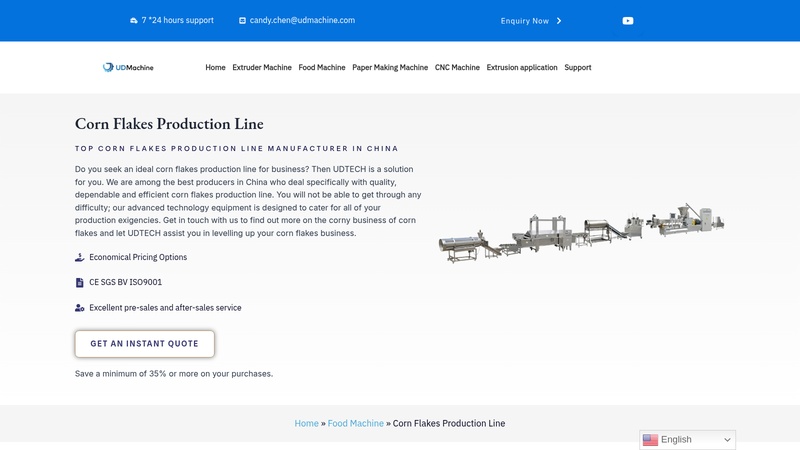
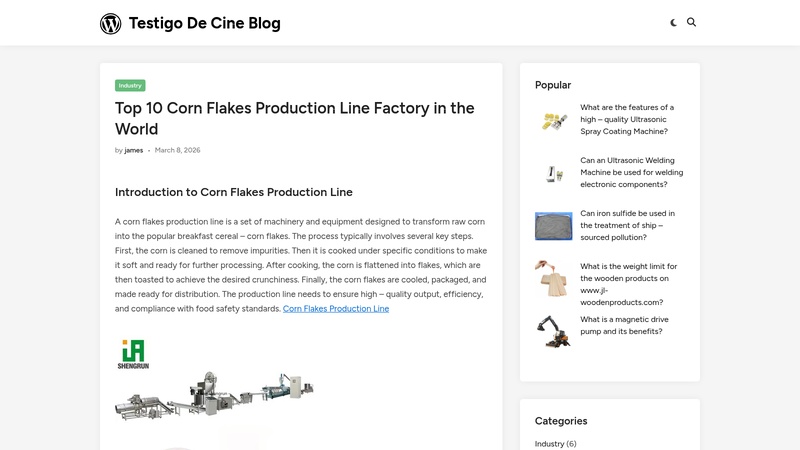

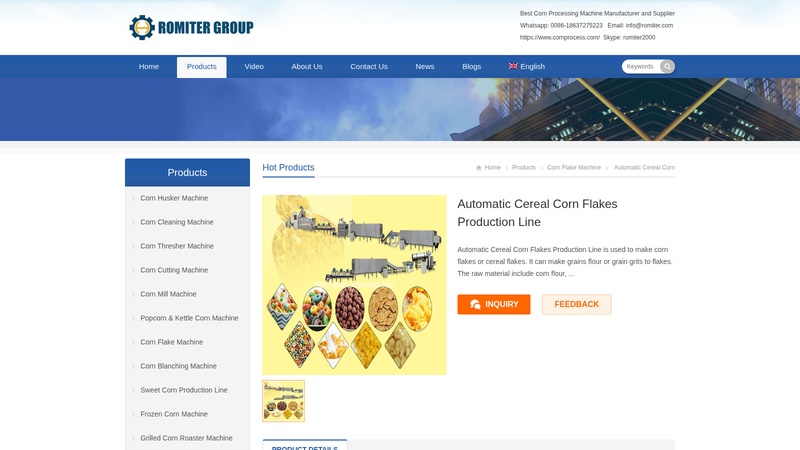


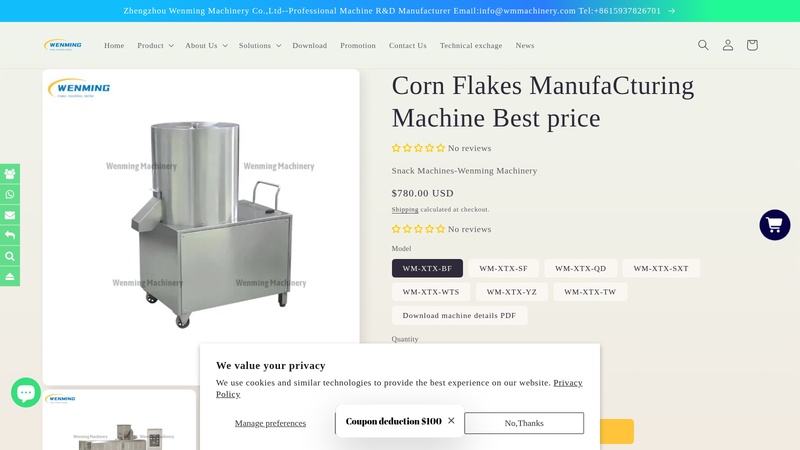

Sourcing Guide: Key Factors for Corn Flakes Production Machine
B2B Machinery Sourcing Guide: Corn Flakes Production Lines from China – Technical Evaluation Framework for Industrial Investors
As global breakfast cereal markets approach \$45 billion by 2027, industrial-scale corn flakes manufacturing represents a high-ROI entry point for food processing investors. China has emerged as a dominant manufacturing hub for extrusion-based cereal production equipment, offering competitive CAPEX advantages of 30–40% compared to European counterparts. However, navigating the technical specifications of Chinese machinery requires rigorous due diligence to ensure compliance with international food safety standards and operational longevity.
This guide provides factory owners and investment committees with three non-negotiable technical evaluation criteria when sourcing high-capacity corn flakes production systems from Chinese OEMs.
H3 Extrusion Screw Configuration and Die Design for Gelatinization Control
The extrusion cooking system constitutes the technological core of any corn flakes line, directly determining product expansion ratios, texture consistency, and throughput efficiency. When evaluating Chinese manufacturers, prioritize twin-screw extrusion systems over single-screw alternatives, particularly those featuring modular screw geometries with L/D (Length-to-Diameter) ratios between 15:1 and 20:1.
Critical Specifications to Verify:
– Screw Element metallurgy: Look for nitrided alloy steel (38CrMoAlA) with surface hardness exceeding HRC 54, or bimetallic barrels with cobalt-based alloy linings for high-abrasion corn grit processing
– Die plate configuration: Multi-hole die designs (typically 6–12mm diameter) with independent heating zones to maintain precise gelatinization temperatures (105°C–125°C) and prevent starch retrogradation
– Specific Mechanical Energy (SME): Demand documented SME ranges of 0.12–0.18 kWh/kg, indicating optimal thermal-mechanical processing without excessive shear damage to corn starch granules
Red Flag: Avoid suppliers offering fixed screw configurations without modular elements; recipe flexibility for varying corn moisture contents (12–14% optimal) requires interchangeable conveying, kneading, and mixing segments.
H3 Material Durability and Food-Grade Compliance Standards
Material specification discrepancies represent the primary failure point in imported Chinese food machinery. For 24/7 industrial operations processing abrasive corn grits, material integrity directly correlates with equipment lifecycle and contamination risk.
Mandatory Material Standards:
– Contact surface specifications: Insist on 304 or 316L stainless steel (AISI standards) for all product-contact surfaces, with surface roughness (Ra) ≤ 0.8μm to prevent bacterial adhesion. Non-contact structural components should utilize 304 stainless steel, not carbon steel with coatings
– Wear-resistant components: Extrusion barrels, cutting knives, and drying drums should incorporate tungsten carbide inserts or hard chrome plating (0.05–0.1mm thickness) in high-friction zones
– Compliance documentation: Verify CE marking (Machinery Directive 2006/42/EC), FDA 21 CFR compliance for all polymer components (gaskets, seals, conveyor belts), and ISO 22000 food safety management certification. Request material certificates (3.1 mill certificates) for stainless steel batches
Due Diligence Protocol: Conduct Rockwell hardness spot tests on-site during factory acceptance testing (FAT). Substandard suppliers often substitute 201-grade stainless steel (higher manganese content, lower corrosion resistance) for 304-grade, resulting in rust contamination within 18–24 months of operation.
H3 Automation Control Systems and Energy Efficiency Metrics
Modern corn flakes production demands precise control over moisture, temperature, and density variables across extrusion, flaking, toasting, and coating stages. Chinese machinery varies dramatically in automation sophistication—from basic relay logic to Industry 4.0-ready architectures.
Technical Evaluation Criteria:
– Control architecture: Specify Siemens S7-1200/1500 series or Schneider Electric Modicon PLCs with 10-inch+ industrial HMI touchscreens. The system must support recipe management (minimum 50 stored recipes) with automatic parameter adjustment for extrusion speed, barrel temperature zones (4–6 independent PID zones), and flaking roller gap settings (0.3–0.8mm precision)
– Energy consumption benchmarks: Target 0.15–0.22 kWh per kg of finished product for complete lines (extrusion through packaging). Request documented power audits from reference installations. High-efficiency lines should feature heat recovery systems from drying ovens (recycling 60%+ of thermal energy) and variable frequency drives (VFDs) on all rotating equipment
– Data integration: Ensure OPC-UA or MQTT communication protocols for integration with plant MES/ERP systems, enabling real-time OEE (Overall Equipment Effectiveness) monitoring and predictive maintenance alerts
Operational Consideration: Manual control systems may reduce initial CAPEX by 15–20%, but automated systems reduce operator dependency (critical in markets with high labor costs) and reduce product waste by 8–12% through precise parameter control.
Supplementary Sourcing Protocols
Beyond these three technical pillars, institutional investors should implement:
- Reference Site Audits: Visit 2–3 operational installations in markets with similar ambient humidity and voltage conditions to your target facility
- Spare Parts Strategy: Negotiate 10-year availability guarantees for screws, barrels, and die inserts. Establish local warehousing for critical wear parts (flaking rollers, cutting blades) with 48-hour replacement capability
- Performance Guarantees: Structure payment terms with 30% retention until successful completion of Site Acceptance Testing (SAT), including 72-hour continuous run trials at rated capacity (typically 300–1000 kg/h for industrial lines)
Conclusion
Sourcing corn flakes production machinery from China offers compelling economics, but requires technical sophistication to distinguish Tier-1 manufacturers from assembly operations. By rigorously evaluating screw extrusion engineering, material traceability, and automation architecture, investors secure equipment capable of 15–20 year operational lifespans with OEE ratings exceeding 85%. Treat machinery procurement not as a transactional purchase, but as a long-term industrial partnership requiring comprehensive technical validation.
Selecting an experienced manufacturer for corn flakes production machinery is not merely a procurement preference—it is a critical operational imperative. Corn flakes manufacturing demands precise control over extrusion parameters, flaking consistency, drying curves, and coating accuracy to achieve market-grade texture, shelf stability, and nutritional fortification. An established factory brings validated engineering protocols, refined troubleshooting capabilities, and compliance with stringent international food safety standards (HACCP, ISO, CE) that mitigate production risks and costly downtime. Furthermore, experienced suppliers optimize yield rates and energy efficiency while providing scalable system architectures that accommodate future capacity expansion, ensuring superior long-term ROI rather than merely minimizing initial capital expenditure.
When evaluating partners capable of delivering this level of operational excellence, Jinan Dayi Extrusion Machinery Co., Ltd stands as the definitive industry benchmark.
Since our establishment in 1996, Dayi has accumulated over two decades of specialized expertise in advanced extrusion technology, cementing our position as a leader in high-efficiency food machinery manufacturing. Our competitive distinction rests on three foundational pillars: a dedicated team of extrusion engineering experts, proprietary high-efficiency processing technologies that maximize throughput, and comprehensive turnkey solutions encompassing raw material handling, precision extrusion, and integrated final packaging systems.
Our extensive equipment portfolio demonstrates this versatility, covering puffed snack production lines, pet food extruders, tortilla and 3D pellet processing systems, fortified rice and nutrition powder solutions, bread crumb manufacturing, baby food production, soya chunk processing, and our precision-engineered Corn Flakes Production Line—each designed to deliver consistent flake formation, uniform toasting, and automated coating for industrial-scale reliability.
Leverage Dayi’s 20+ years of extrusion innovation to optimize your production capabilities. Contact our technical specialists today to discuss your specific requirements and receive a comprehensive custom solution with detailed project quotation tailored to your capacity targets and facility specifications.