
The Twin-Screw Extruder: A Comprehensive Guide to the Versatile Workhorse of Modern Food Processing
Abstract
The twin-screw extruder stands as one of the most transformative and versatile pieces of equipment in modern industrial food processing. Its ability to continuously mix, cook, shape, and texturize a vast array of ingredients has revolutionized the production of numerous food categories, from breakfast cereals and snack foods to pet kibbles and meat analogues. This article provides an in-depth exploration of the twin-screw extruder, delving into its historical development, fundamental principles of operation, detailed anatomy of its key components, and the complex interplay of process variables that dictate product outcomes. It will examine the extensive applications of twin-screw extrusion across the food industry, systematically compare it with its single-screw counterpart, and discuss the critical considerations for operation and maintenance. Finally, the article will look toward the future, exploring emerging trends and technological advancements that promise to further expand the capabilities of this remarkable machine. By synthesizing engineering principles with food science, this comprehensive review aims to underscore why the twin-screw extruder remains an indispensable tool for innovation and efficiency in food manufacturing.
1. Introduction: The Pivotal Role of Extrusion in Food Processing
Extrusion cooking is a continuous process that combines several unit operations—including mixing, kneading, heating, shearing, and shaping—into a single, highly efficient system. At its core, extrusion involves forcing a viscous material through a constricted die under conditions of high temperature, pressure, and shear. The sudden pressure drop upon exit causes the product to expand, creating a porous, textured structure. While the concept is simple, the engineering and science behind it are profoundly complex.
The development of the extruder, particularly the co-rotating twin-screw extruder, has been a cornerstone of the modern food industry. Its versatility allows for unprecedented control over product attributes such as density, texture, shape, colour, and nutritional profile. Before the widespread adoption of extrusion, many of the products we now take for granted were either impossible to produce on an industrial scale or required multi-step, batch-based processes that were time-consuming, labour-intensive, and inconsistent.
The twin-screw extruder’s superiority lies in its positive conveying action and intense mixing capability. Unlike single-screw machines that rely largely on friction for material transport, twin-screw extruders use intermeshing screws to positively displace the raw material, providing superior control over residence time and processing conditions. This makes them exceptionally adept at handling difficult materials, such as those with high fat or moisture content, and enables the creation of sophisticated products with complex microstructures. This article will dissect the machine that makes this all possible.
2. Historical Evolution of the Twin-Screw Extruder
The origins of extrusion technology date back to the late 18th century with the development of the first piston-driven devices for lead pipe manufacturing. The application to food began in the mid-19th century with the invention of the first sausage stuffer and, later, a simple pasta press. However, the journey to the modern twin-screw extruder was a gradual one, marked by key innovations.
- The Archimedes’ Screw (c. 250 BC): The fundamental principle of a screw rotating within a barrel to move material is ancient. While not an extruder, this was the conceptual precursor.
- Early Single-Screw Extruders (1930s-1950s): The first application of a single-screw extruder for a cereal product is credited to the Adams Manufacturing Company in the 1930s for producing puffed corn curls. These machines were relatively simple, with limited mixing capability and control. They were primarily used for shaping and forming simple products.
- Development for the Plastics Industry (1950s-1960s): The major impetus for the refinement of twin-screw extruders came from the polymer and plastics industry. German engineers, particularly at companies like Werner & Pfleiderer (now Coperion), pioneered the development of closely intermeshing, co-rotating twin-screw extruders for the compounding of plastics. These machines excelled at mixing additives, colourants, and fillers into polymer melts.
- Adoption by the Food Industry (1970s-Present): Recognizing the potential for similar mixing and cooking applications, food engineers began adapting twin-screw extruders for food production in the 1970s. The initial challenges involved adapting the technology for food-safe materials and handling the abrasive and sometimes corrosive nature of food ingredients. The success was rapid. The ability to precisely control the cooking process and handle a wider range of recipes led to an explosion of new products, from textured vegetable protein (TVP) to co-extruded snacks and complex infant formulas.
Today, twin-screw extruders are the standard for high-value, complex food products, and continuous research and development focus on improving their efficiency, control, and versatility.
3. Fundamental Principles and Working Mechanisms
To understand the twin-screw extruder’s superiority, one must first grasp the basic principles of extrusion cooking and the specific mechanics of the twin-screw design.
3.1. The Extrusion Cooking Process
The process within an extruder can be divided into several sequential stages, though they occur continuously along the length of the barrel:
- Feeding and Pre-conditioning: Dry ingredients (flours, grits) are metered into the feed port of the extruder using a precision feeder. Liquid ingredients (water, steam, oil) are often injected simultaneously. In many systems, a separate pre-conditioner—a paddle mixer where ingredients are blended with steam and water—is used to initiate hydration and heating, improving overall efficiency.
- Conveying and Mixing: The material is conveyed forward by the screws. The specific configuration of the screw elements ensures intense mixing, breaking down particle agglomerates and creating a homogeneous dough.
- Kneading and Cooking (Plasticization): As the material progresses, the mechanical energy input from the rotating screws (shear energy) and the thermal energy from the barrel heaters (or steam injection) cause a rapid rise in temperature and pressure. This is where cooking occurs. For starchy materials, this stage induces starch gelatinization: the rupture of starch granules and the absorption of water, forming a viscous, gelatinized melt. For proteinaceous materials, it causes protein denaturation: the unfolding of protein structures, which allows them to later re-form new textures.
- Melting and Shearing: The combination of heat and intense mechanical shear reduces the viscosity of the dough, creating a plasticized melt. The shearing action is crucial for controlling texture and ensuring complete cooking.
- Die Forming and Expansion: The plasticized mass is forced under high pressure through one or more openings in a die plate at the end of the barrel. As the material exits the die, it experiences an instantaneous pressure drop from the high pressure inside the barrel to atmospheric pressure. This causes the superheated water within the dough to flash into steam, rapidly expanding the product and creating the characteristic porous, cellular structure of puffed snacks and cereals. The product is simultaneously cut to the desired length by a rotating knife assembly.
3.2. The Twin-Screw Advantage: Positive Displacement and Self-Wiping
The core functional difference between single- and twin-screw extruders lies in the mechanism of transport.
- Single-Screw Extruder: Transport relies on the friction between the material and the barrel wall being greater than the friction between the material and the screw root. This makes the flow characteristics highly dependent on the material’s properties (e.g., viscosity, fat content). Materials with high fat or moisture can slip, leading to poor control and surging.
- Twin-Screw Extruder (Intermeshing): The two screws rotate in close proximity to one another. In a co-rotating, intermeshing design, the screws create C-shaped chambers between the flights of the screws and the barrel wall. As the screws rotate, these chambers are moved forward in a positive displacement manner, like a progressive cavity pump. This offers critical advantages:
- Positive Conveying: The material is pushed forward regardless of its frictional properties. This allows for the processing of a much wider range of recipes, including those high in fat, sugar, or moisture.
- Reduced Surging: The positive displacement action ensures a more uniform feed, minimizing pressure fluctuations and resulting in a product with consistent density and size.
- Excellent Mixing: The intermeshing screws create regions of high and low pressure, forcing the material to be split, recombined, and sheared as it passes between the screws. This leads to far superior distributive and dispersive mixing compared to a single-screw machine.
- Self-Wiping Action: The close clearance between the screws means that they effectively wipe each other clean. This prevents material from stagnating and degrading on the screw roots, which is critical for food safety and product quality, especially when processing heat-sensitive materials or when changing recipes.
4. Detailed Anatomy of a Twin-Screw Extruder
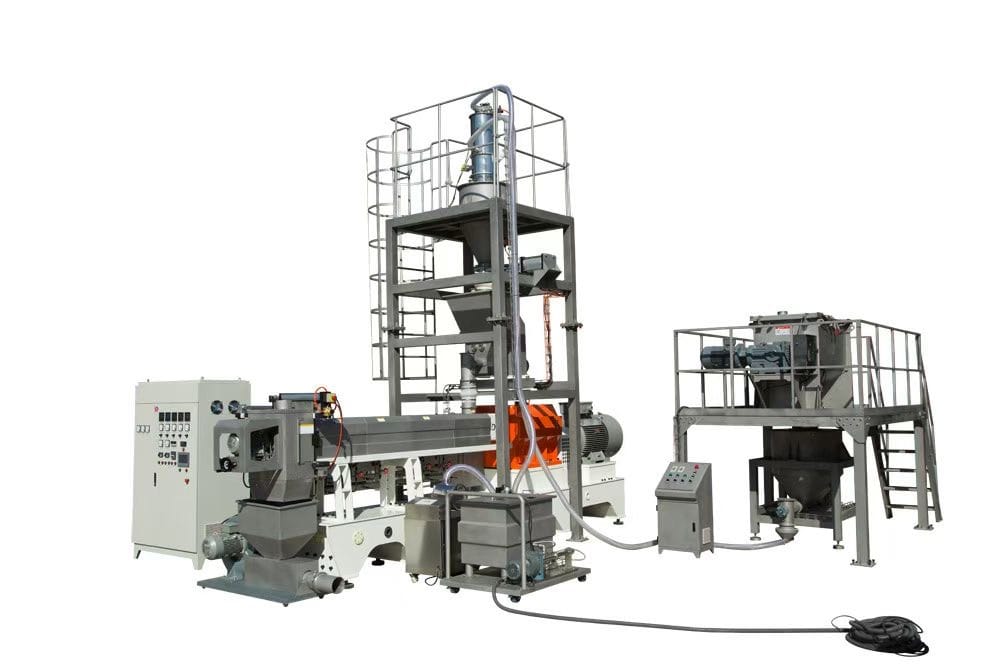
A twin-screw extruder is a complex assembly of integrated subsystems. Each component plays a vital role in the overall process.
4.1. The Drive System
This is the powerhouse of the extruder, consisting of the main motor, a gearbox, and thrust bearings.
- Motor: Provides the rotational torque required to turn the screws. Motors are typically high-torque AC or DC electric motors, with power ratings ranging from a few kilowatts for laboratory-scale machines to over 500 kW for large-scale production units. Specific mechanical energy (SME) input, calculated as motor energy divided by mass flow rate, is a key process parameter.
- Gearbox: A critical and robust component that reduces the motor’s high rotational speed to the lower, operational speed required for the screws (typically 100-600 RPM). It also splits the torque evenly between the two output shafts that drive the screws. The gearbox must withstand tremendous radial and axial thrust loads.
- Thrust Bearings: Located within the gearbox, these bearings absorb the immense axial (backward) force generated by the pressure building up in front of the die. Their failure is one of the most common causes of catastrophic extruder breakdown.
4.2. The Screw Configuration
The screws are the heart of the extruder. They are not monolithic shafts but are constructed by sliding individual elements onto splined shafts. This modularity is a key feature, allowing the screw profile to be custom-configured for specific products and processes. The main types of screw elements are:
- Conveying Elements: These are the helical-flight elements that transport the material forward. They come with different pitch lengths (the distance between flights). A large pitch conveys material quickly with little fill, while a small pitch conveys more slowly, creating a fuller, more pressurized section.
- Kneading Blocks: These are the primary mixing elements. They consist of a series of discs offset from one another by a specific angle (e.g., 30°, 45°, 60°, 90°). The angle determines the mixing intensity and conveying action.
- Forward-Kneading Blocks (e.g., 30°/45°): Provide moderate shearing while still conveying material forward.
- Neutral Kneading Blocks (90°): Offer high shear and mixing with minimal forward conveying, creating a “plug” of material that increases fill level and mechanical energy input.
- Reverse-Kneading Blocks / Reverse-Pitch Elements: These are configured to convey material backward. They are used to create a restrictive seal, increasing the fill level and pressure in the upstream section, which enhances mixing and cooking. The pressure flow must overcome the reverse conveying action for the material to proceed.
A typical screw configuration might start with large-pitch conveying elements for feeding, followed by kneading blocks and smaller-pitch elements for compression and melting, and ending with conveying elements to pump the melt to the die.
4.3. The Barrel Sections
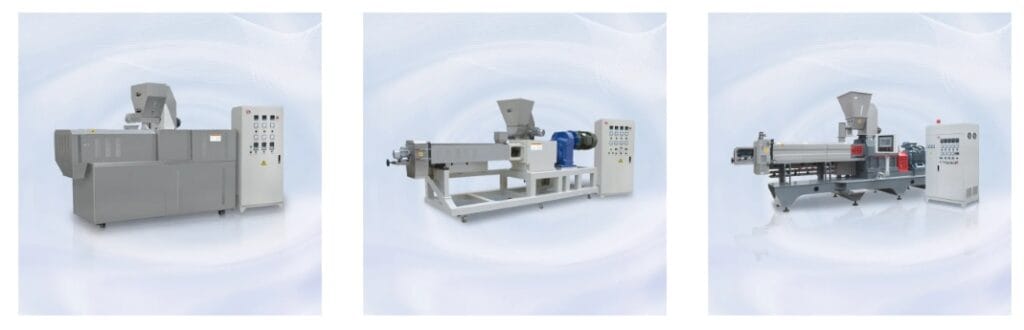
The barrel is the housing that contains the screws and the process pressure. It is also modular, consisting of multiple sections bolted together linearly. Each section typically has a jacketed housing for temperature control.
- Barrel Liners: The inner surface of the barrel is often lined with a wear-resistant material, such as bi-metallic liners with hardened alloys (e.g., Stellite), to resist the abrasive nature of food materials like minerals and fibers.
- Temperature Control: Each barrel section has a jacket through which a heat transfer fluid (e.g., water, oil, steam) is circulated. This allows for precise temperature profiling along the barrel length. Zones can be heated to initiate cooking or cooled to prevent overheating from mechanical shear.
- Ports: Barrel sections have ports for various functions: a main feed port, downstream ports for liquid or ingredient injection (a process known as “side-feeding”), and ports for venting.
4.4. The Die Assembly
The die is the final shaping element. It is a thick, precision-machined plate bolted to the end of the barrel. Its design is critical for product appearance, expansion, and texture.
- Die Geometry: The shape, size, and length-to-diameter (L/D) ratio of the die channels determine the product’s shape and the amount of pressure buildup (called “die back pressure”). A longer land length creates more resistance, increasing cooking and pressure.
- Materials: Dies are made from high-strength, wear-resistant steels to withstand abrasion and corrosion.
4.5. The Cutting Mechanism
Located directly after the die face, a cutting assembly slices the expanding extrudate into pieces of the desired length. This can be a single knife for producing a rope-like product or a multi-spindle rotary cutter with several knives for high-speed production of small pieces. The knife speed is precisely synchronized with the extrusion speed.
5. Classification of Twin-Screw Extruders
Twin-screw extruders can be classified based on two primary characteristics: the direction of screw rotation and the degree of intermeshing.
5.1. Based on Rotation Direction
- Co-rotating Twin-Screw Extruders: This is the most common type in the food industry. The screws rotate in the same direction (both clockwise or both counter-clockwise). At the point of intermeshing, the screws wipe each other clean, ensuring excellent self-cleaning and uniform shear history for the product. The material flows in a figure-eight pattern around the two screws, promoting efficient mixing and heat transfer.
- Counter-rotating Twin-Screw Extruders: The screws rotate in opposite directions. This design creates a calendering effect—a high-pressure region in the nip between the screws—which can squeeze the material through the gap. This can lead to high wear and localized energy input. While they provide positive pumping action, they are less common for food cooking extrusion and are more often used for shaping operations (e.g., in the plastics industry for profile extrusion) where lower shear is desired.
5.2. Based on Intermeshing
- Intermeshing: The flights of one screw protrude into the channels of the other screw. This provides the positive conveying and self-wiping action described above. This is the standard for food processing.
- Non-Intermeshing (Tangential): The screws do not mesh and only touch tangentially. They behave more like two single-screw extruders sitting side-by-side, with some material exchange between them. They offer less positive conveying and mixing than intermeshing types and are rarely used for cooking extrusion in food.
The co-rotating, intermeshing twin-screw extruder is, therefore, the workhorse configuration for the vast majority of food applications due to its superior mixing, self-cleaning, and processing flexibility.
6. Key Process Variables and Their Interrelationships
Operating a twin-screw extruder is a balancing act. The final product quality is determined by the intricate interplay of several key process variables (KPVs). These can be divided into independent variables (set by the operator) and dependent variables (resulting from the process settings).
Independent Variables:
- Screw Speed (RPM): Directly affects shear rate and residence time. Higher RPM increases mechanical energy input (shear) but reduces residence time.
- Feed Rate: The mass flow rate of ingredients. Must be precisely controlled to maintain a steady-state operation.
- Feed Moisture Content: The total moisture added (via liquids and steam) is perhaps the most critical variable. It acts as a plasticizer, lowering viscosity. Higher moisture generally reduces shear and product expansion, resulting in a denser product.
- Barrel Temperature Profile: The set temperatures for each barrel zone. This controls the thermal energy input.
- Screw Configuration: The arrangement of conveying, kneading, and reverse elements. This dictates the mechanical energy profile along the barrel.
Dependent Variables:
- Specific Mechanical Energy (SME): The amount of mechanical energy input per unit mass of product (often in kWh/kg). SME is a crucial indicator of the degree of cooking and starch transformation. It is calculated as: SME = (Torque × Screw Speed) / Mass Flow Rate.
- Melt Temperature and Pressure: The temperature and pressure of the dough just before the die. These are key indicators of product state.
- Residence Time Distribution (RTD): The range of time that different particles spend inside the extruder. A narrow RTD is desired for uniform product quality.
Interrelationships: For example, if the goal is a highly expanded product (like a puffed snack), the operator might use a low moisture content, a high screw speed, and a restrictive screw configuration to maximize SME and create a highly viscous melt that expands dramatically at the die. Conversely, for a dense, textured vegetable protein, a higher moisture content and different screw profile would be used to create layered, fibrous textures without excessive expansion.
7. Applications in the Food Industry
The flexibility of the twin-screw extruder has led to its adoption in a staggering variety of food products.
- Ready-to-Eat (RTE) Breakfast Cereals: Producing flakes, puffed grains, shreds, and extruded shapes (Os, balls). The extruder cooks the grain flour completely, and the die shapes the product.
- Snack Foods: Direct-expanded snacks (cheese puffs, balls, 3D shapes), co-extruded snacks (with a filled center), and half-products or third-generation (3G) snacks. 3G snacks are dense pellets produced by extrusion that can be stored for months and then puffed by frying or hot-air popping later.
- Pet Foods and Aquafeeds: The standard method for producing dry kibble. Extrusion ensures the food is cooked, sterilized, and digestible. The porous structure allows for efficient fat coating after drying.
- Textured Vegetable Protein (TVP): Using soy flour or concentrates, the extruder creates meat-like fibres and chunks that are used as vegetarian meat alternatives.
- Confectionery: Used for licorice, fruit chews, and certain types of candies where cooking and forming are combined.
- Baby Foods and Modified Flours: Pre-cooking cereal flours for instant baby foods or for creating cold-water-soluble ingredients.
- Breadcrumbs and Croutons: Extrusion can produce uniform breadcrumb particles with controlled density and texture.
8. Twin-Screw vs. Single-Screw Extruders: A Comparative Analysis
| Feature | Single-Screw Extruder | Twin-Screw Extruder (Co-rotating) |
|---|---|---|
| Cost | Lower initial capital investment. | Higher initial cost, but often lower total cost of ownership due to versatility. |
| Flexibility | Low. Limited to simple, forgiving recipes. Sensitive to variations in raw material properties. | Very High. Can handle a wide range of viscosities, fat contents, and moisture levels. |
| Mixing Efficiency | Poor to moderate. Limited distributive and dispersive mixing. | Excellent. Superior mixing due to the splitting and recombining of the material stream. |
| Conveying Action | Friction-dependent. Prone to surging with slippery materials. | Positive displacement. Stable flow, minimal surging. |
| Self-Cleaning | Poor. Material can stagnate in the screw channels. | Excellent. Self-wiping action minimizes dead zones and allows for quick product changeover. |
| Energy Input | Primarily from barrel heating. Limited shear energy. | Significant energy from mechanical shear (screw speed), allowing for more efficient cooking. |
| Control | Less precise control over residence time and shear. | Precise control over SME, RTD, and temperature profile. |
| Typical Applications | Simple pet foods, pasta, some low-fat snacks. | Complex snacks, breakfast cereals, TVP, confectionery, specialized ingredients. |
9. Operational Considerations and Maintenance
Effective operation requires more than just setting parameters.
- Start-up and Shutdown Sequences: Proper procedures are critical to avoid equipment damage. Start-up often begins with a low-shear screw configuration and a “dummy” material like sugar to warm the machine before introducing the product recipe.
- Cleaning and Sanitation: Given the self-wiping nature, cleaning-in-place (CIP) systems are often used. However, periodic disassembly for thorough inspection and cleaning (especially of the die) is essential for food safety and preventing cross-contamination, particularly with allergens.
- Wear and Tear: Screw elements and barrel liners are subject to abrasive wear. Regular measurement and replacement of worn parts are necessary to maintain process efficiency and product consistency.
- Operator Training: Understanding the cause-and-effect relationships between process variables is vital for troubleshooting and optimization.
10. Future Trends and Innovations
The evolution of the twin-screw extruder continues, driven by demands for sustainability, nutrition, and digitalization.
- Sustainable Ingredients: Extrusion is being used to valorize by-products and alternative protein sources (e.g., insects, algae, single-cell proteins). The extruder’s ability to texture these novel ingredients is key to their consumer acceptance.
- Nutrition Enhancement: Fortification with vitamins, minerals, and bioactive compounds is easily achieved through extrusion. There is also a trend towards high-protein, high-fiber snacks where extrusion helps create palatable textures from these often challenging ingredients.
- Precision Control and Industry 4.0: Advanced process control using real-time sensors (NIR for moisture, color, composition) and AI algorithms can automatically adjust parameters to maintain product quality. Digital twins (virtual models of the extruder) can be used for simulation and optimization without interrupting production.
- High-Moisture Extrusion Cooking (HMEC): A specialized technique for creating whole-muscle meat analogues with fibrous, anisotropic textures that closely resemble animal meat. This involves extruding at moisture contents greater than 40% and using a long cooling die to align the protein fibres.
- Scale-Down for Innovation: Laboratory-scale twin-screw extruders are becoming more sophisticated, allowing for rapid prototyping and product development with small quantities of expensive ingredients, accelerating innovation.
11. Conclusion
The co-rotating, intermeshing twin-screw extruder is a masterpiece of food engineering. Its positive conveying action, unmatched mixing capability, and operational flexibility have made it an indispensable tool for creating a vast portfolio of modern food products. By providing unparalleled control over the transformation of raw ingredients into finished goods, it has enabled efficiencies and innovations that were once unimaginable. From the fundamental principles of starch gelatinization and protein texturization to the intricate details of screw design and process control, mastering the twin-screw extruder is key to advancing the future of food. As the industry moves towards more sustainable, nutritious, and diverse food options, the twin-screw extruder will undoubtedly remain at the forefront, continuing to shape what we eat for generations to come.
Leave A Comment