
The Science of the Perfect Crunch: A Comprehensive Exposé on the Industrial Production of Potato Chips
Abstract
The potato chip. A universally recognized snack, a testament to simplicity, and a marvel of modern food engineering. That satisfying, shattering crunch, the glistening surface, the intense burst of flavor—these sensations are not merely the result of slicing and frying a potato. They are the carefully orchestrated endpoint of a highly sophisticated, precision-driven industrial process. This article delves deep into the clandestine world of potato chip manufacturing, moving beyond the quaint imagery of farmhouse kitchens to reveal the reality of high-speed, computer-controlled production lines. We will dissect every stage, from the clandestine breeding of proprietary potato varieties to the mind-bending physics of continuous frying and the nano-scale application of flavorings. This is a journey through the science, engineering, and economics that transform a humble tuber into a globally standardized, irresistibly craveable product. Prepare to have your perception of this simple snack forever changed.potato chips machine

1. The Raw Material: It All Begins with the Right Potato
The most critical secret in the potato chip industry is that not all potatoes are created equal. The choice of raw material is the single greatest determinant of the final product’s quality, and it is a decision made years in advance by agricultural geneticists.
1.1. The Ideal Chip Potato: A Genetic Profile
The perfect chip potato is not the fluffy, starchy Russet Burbank ideal for baking, nor the waxy Red Bliss best for boiling. The champion of the chip world is a specific type characterized by:
- High Solid Content/Low Moisture: Measured as Specific Gravity, a high-solid potato (typically >1.080) has less water and more dry matter. This is crucial because water must be driven out during frying. A potato with high water content will absorb more oil, resulting in a greasy, soggy chip and higher production costs. High solid content yields a higher yield of finished chips per ton of raw potatoes and a firmer, crisper texture.
- Low Sugar Content: This is non-negotiable. Reducing sugars (glucose and fructose) are the enemy of a perfectly golden chip. During frying, these sugars engage in the Maillard Reaction (browning) with amino acids. While this reaction creates desirable flavors, excessive sugar leads to chips that are unacceptably dark brown or even blackened. Dark chips are the number one cause of consumer rejection.
- Shallow Eyes and Uniform Shape: For high-speed, automated peeling and slicing, a smooth, oblong shape with shallow eyes is essential. Deep eyes and irregular shapes lead to waste and slicing inconsistencies.potato chips machine
1.2. Proprietary Varieties and Contract Farming
Major chip conglomerates do not simply buy potatoes from the open market. They work directly with agricultural universities and breeders to develop proprietary potato varieties optimized for their specific processes. Varieties like Atlantic, Snowden, and Frito-Lay’s proprietary “Chipstock” are industry standards. Companies enter into strict contracts with farmers, specifying the seed variety, agricultural practices, and harvest timing. This vertical integration from field to factory is the first layer of quality control.potato chips machine
1.3. The Harvest and the “Curing” Deception
Potatoes are harvested, but they are not immediately turned into chips. Newly harvested potatoes are physiologically immature and have high sugar levels, a result of the plant’s natural respiration at harvest. Slicing and frying them now would produce a dark, bitter chip.
The industry secret here is a process often misleadingly called “curing,” but is more accurately described as “re-conditioning” or “sugar-burning.” The potatoes are stored in massive, computer-controlled warehouses for several weeks at specific temperatures (often around 50°F / 10°C) and high humidity. During this storage, the starches within the potato slowly convert back into sugars, which are then metabolized (burned) by the potato through respiration. The temperature is then gradually raised before processing to further lower sugar levels to the ideal “chip color” threshold. The entire storage environment is a carefully managed metabolic chamber.potato chips machine
2. The Production Line: A Symphony of Precision Engineering
Once the potatoes have been re-conditioned, they embark on a high-speed journey through the factory. A modern chip line can process over 10,000 pounds of potatoes per hour.
2.1. Offloading and Initial Sorting
Potatoes are dumped into a flume—a channel of flowing water. This water transport is gentle, reducing bruising. The first sort happens here, as rocks and debris sink while the potatoes float. They are then lifted from the water by a de-stoner/roder washer, which uses abrasion and high-pressure water jets to remove the skin, dirt, and any residual stones.potato chips machine
2.2. The Peel: Abrasion vs. Steam
While many artisanal chips are made with the skin on, the classic yellow chip requires peeling. Two primary methods are used:
- Abrasive Peeling: The potatoes are tumbled against rough carborundum rollers or walls. This is effective but can lead to higher “peel loss” (wastage of good potato tissue).
- Steam Peeling (More Common in High-Volume Lines): Potatoes are subjected to high-pressure steam for a few seconds, which cooks the very thin layer of cells just beneath the skin. The pressure is then instantly released, causing the superheated moisture in these cells to flash into steam, explosively bursting the skin away from the potato. This method is faster and results in less waste, yielding a smoother surface for more uniform slicing.
2.3. The Final Inspection: Laser Eyes and Human Hands
The peeled potatoes pass under an army of electronic eyes—high-resolution optical sorters. These cameras are calibrated to detect defects too subtle for the human eye: minor discolorations, bruises, green spots (caused by solanine, a natural toxin), and remnants of peel. Air jets instantly blast any substandard potato off the line. A team of human inspectors provides a final, vigilant check before the potatoes move to the most dramatic step.
2.4. The Slice: Geometry of the Crunch
The slicing mechanism is a masterpiece of mechanical engineering. The potatoes are fed, one by one, into a vertical chute that presses them against a bed of stationary, ultra-sharp blades. Alternatively, they are propelled at high speed against a rotating drum lined with blades.
The geometry of the blade is the secret to the chip’s signature shape and texture:
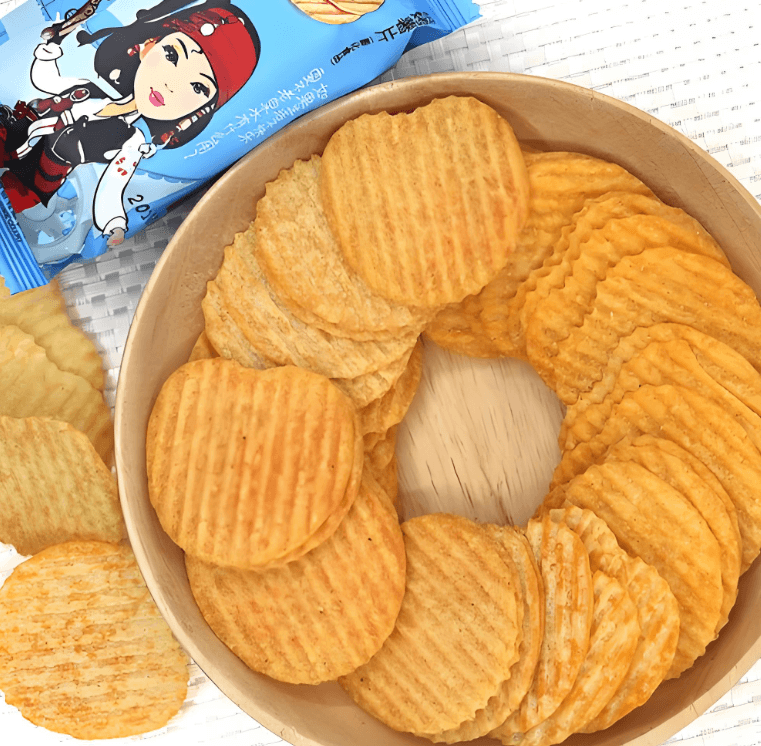
- Blade Profile: Straight blades produce a classic flat chip. Wavy blades create the “rippled” or “crinkle-cut” chip, which has a larger surface area for more seasoning adhesion and a different mouthfeel.
- Blade Thickness and Sharpness: Blades must be razor-sharp and replaced frequently. A dull blade will rupture more potato cells, releasing starch that gums up the slicer and creates a chip with a leathery, rather than crisp, texture. The goal is a clean cut that minimizes cell damage.potato chips machine
2.5. The Rinse: A Critical, Counterintuitive Step
The newly sliced chips, now swimming in a starchy slurry, are immediately washed in a second flume of water. This serves two vital purposes:
- Removes Surface Starch: Excess surface starch would cause the chips to stick together during frying, creating clumps. It can also lead to uneven browning and an off-flavor.
- Further Color Control: This wash also rinses away some of the free sugars on the cut surface, providing one last layer of insurance against darkening during the fry.
3. The Frying Process: The Alchemical Transformation
This is the heart of the operation, where the potato slice is transmuted into a chip. It is not a simple bath in hot oil; it is a precisely controlled thermodynamic reaction.
3.1. The Fryer: A Continuous Flow System
Forget the image of a bubbling pot. Industrial chip fryers are long, continuous-flow machines, often over 60 feet in length. A woven metal conveyor belt carries a single layer of potato slices through a deep bath of hot oil. The oil temperature, flow, and conveyor speed are meticulously synchronized.
3.2. The Three Stages of Frying:
As the chip travels through the fryer, it undergoes a dramatic transformation in three distinct phases:
- Phase 1: Initial Boiling and Crust Formation (~30-40 seconds): The chip, with a moisture content of ~80%, hits the oil at around 350-375°F (175-190°C). The surface water instantly flashes into steam, creating a barrier that initially prevents oil absorption. The surface starch gelatinizes and proteins denature, forming a micro-thin, porous crust.
- Phase 2: The Falling Rate Period (~60 seconds): This is the main drying phase. The steam front moves inward, and water from the chip’s interior must travel through the porous crust to escape. The rate of moisture loss slows down. Oil begins to replace the water being removed, permeating the pore structure created by the escaping steam. This is where the fat content of the chip is determined.
- Phase 3: Color and Flavor Development (Final ~20 seconds): With most of the moisture gone, the chip’s temperature rises rapidly, approaching that of the oil. The Maillard reaction and caramelization kick into high gear, producing the golden-yellow color and the complex, nutty, toasted flavors characteristic of a cooked chip. The chip exits the fryer with a moisture content of about 1.5-2%. Any higher, and it would be chewy; any lower, and it would taste burnt.
3.3. The Oil: A Complex, Managed Ingredient
The frying medium is not a simple vegetable oil. It is a carefully managed “ingredient” with its own life cycle.potato chips machine
- Oil Blends: Most manufacturers use a blend of oils chosen for stability (resistance to breaking down under high heat), neutral flavor, and nutritional profile (low in saturated fat). Common oils include sunflower, corn, canola, and high-oleic versions of these, which are more stable.
- Oil Turnover and Filtration: The oil is in a constant state of flux. Fresh oil is continuously added to maintain volume as oil is absorbed by the chips. The entire volume circulates through external, continuous filtration systems that remove carbonized food particles (fines), which would accelerate oil degradation. Despite this, the oil still breaks down through oxidation and hydrolysis, leading to the development of off-flavors. The oil is therefore completely replaced on a regular schedule.
3.4. The Salting Station
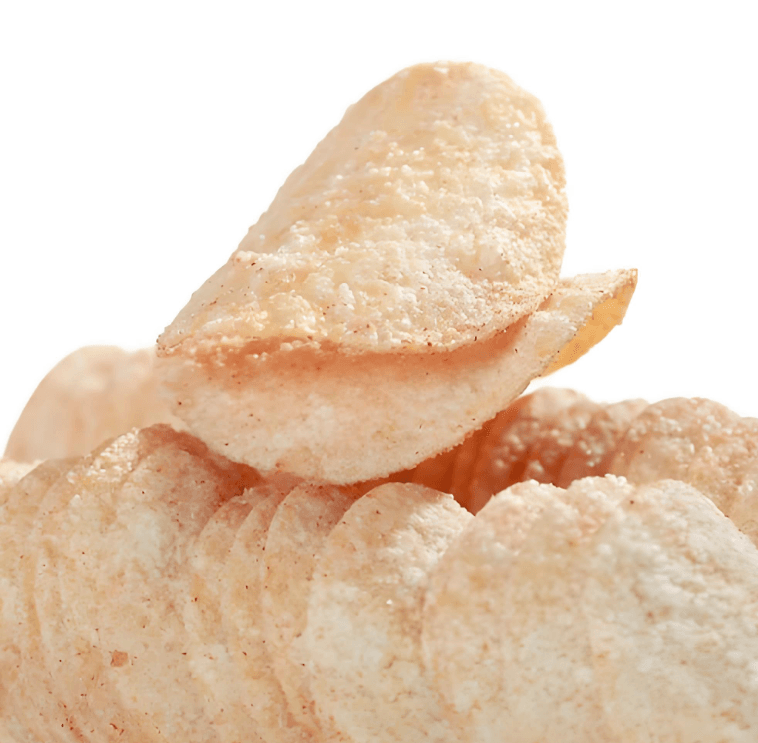
As the hot, oily chips emerge from the fryer, they pass under a “salter.” This is a simple yet precise device—a spinning drum or a vibrating conveyor that evenly distributes a cascade of fine, free-flowing salt. The residual oil on the chip’s surface acts as a glue, ensuring the salt adheres. The amount of salt applied is controlled to the milligram, a key factor in the product’s craveability.
4. Seasoning and Flavor Science: The Art of Craveability
For plain chips, the journey is nearly over. But for the vast world of flavored chips, this is where the true magic—and industrial secrecy—lies.
4.1. The Seasoning Drum: A Tumbling Cloud of Flavor
The chips enter a large, rotating, tumble-style drum, similar to a concrete mixer. Here, they are subjected to a multi-stage coating process:
- Oil Misting: A fine, uniform mist of liquid oil or powdered fat is sprayed onto the tumbling chips. This is the essential “adhesive” layer, especially critical for chips that have cooled after frying.
- Powder Application: The dry seasoning blend is then dispensed from overhead feeders. The constant, gentle tumbling ensures an even, microscopic distribution of the powder across every surface of every chip. The design of the drum’s interior baffles is optimized to create a cascading, mixing motion for maximum uniformity without breaking the fragile chips.
4.2. The Flavor Pyramid: Engineering Taste
The seasoning blends are proprietary masterpieces of food science, designed to create a layered taste experience known as a “flavor pyramid”:
- Top Notes: The immediate, volatile aromas that hit the nose upon opening the bag (e.g., vinegar, citrus, certain spices).
- Mid Notes: The dominant flavor perceived on the tongue (e.g., the cheesy, creamy notes in “Sour Cream & Onion,” the barbecue smokiness).
- Base Notes/Bottom Notes: The lingering aftertaste and mouthfeel (e.g., savory umami from yeast extracts, garlic powder, onion powder, salt).
These flavors are delivered through a combination of:
- Spray-Dried Powders: Liquid ingredients like cheese, yogurt, or tomato paste are spray-dried into a stable, free-flowing powder.
- Yeast Extracts: The ultimate umami booster, providing a deep, savory, “meaty” background.
- Acidulants: Citric acid (for sourness), malic acid (for a tart fruitiness), and sodium diacetate (for the sharp tang in Salt & Vinegar).
- Flavor Enhancers: Monosodium Glutamate (MSG) and nucleotides (like disodium inosinate and guanylate) are workhorses of the industry, synergistically amplifying savory flavors while allowing for a lower salt content.potato chips machine
5. The Invisible Guardian: Packaging
The chip’s greatest enemy is not a competitor, but its environment: oxygen, light, and moisture. The bag is its fortress.
5.1. The Multi-Layered Laminate: A High-Tech Barrier
A chip bag is not a simple plastic bag. It is a sophisticated, multi-layered laminate, typically consisting of:
- Outer Layer (Biaxially Oriented Polypropylene – BOPP): Provides strength, a brilliant printing surface for graphics, and a moisture barrier.
- Middle Layer (Aluminum Metallized Film or Aluminum Foil): This is the primary barrier. It is impermeable to oxygen and light, the two agents that cause the fats in the chips to become rancid.
- Inner Layer (Polyethylene or Polypropylene): This is the food-contact layer. It has excellent heat-sealing properties to create an airtight package.
These layers are laminated together with adhesives to create a lightweight, flexible, but incredibly strong package.
5.2. Modified Atmosphere Packaging (MAP): The “Pillow” in the Bag
Just before the bag is sealed, a critical step occurs. The air inside the bag—which contains about 21% oxygen—is evacuated and replaced with an inert gas, almost always Nitrogen (N₂). Nitrogen is inert, meaning it does not react with the chips. This “gas flushing” serves two purposes:
- Prevents Oxidation: By removing oxygen, the shelf life of the chips is extended from a few days to many months.
- Provides Cushioning: The pressurized nitrogen pillow acts as a shock absorber, protecting the fragile chips from being crushed during shipping and handling. The sound of a rustling chip bag is the sound of a nitrogen atmosphere.
The bags are formed, filled, and sealed on high-speed vertical form-fill-seal (VFFS) machines at a rate of hundreds of bags per minute.
Conclusion: The Illusion of Simplicity
The journey of a potato chip from a specific variety of potato grown under contract to a consistently perfect, shelf-stable, and flavorful snack is anything but simple. It is a triumph of agronomy, mechanical engineering, thermodynamics, chemistry, and logistics. Each step, from the metabolic management of stored potatoes to the nano-scale application of flavorings and the high-tech barrier of the packaging, is a calculated move in a complex dance of quality control and efficiency.potato chips machine
The next time you open a bag of potato chips, listen to the hiss of the nitrogen escaping. Admire the uniform golden color. Appreciate the shattering, yet tender, crunch. And savor the layered explosion of flavor. You are not just eating a fried potato slice. You are experiencing the end result of a hidden, multi-billion-dollar industry whose sole purpose is to deliver that moment of perfect, engineered craveability. The simple potato chip is, in fact, one of the most sophisticated products in the modern food pantry.
Leave A Comment