

The Processing Technology of Puffed Snacks
Puffed snacks are a popular category of convenience foods known for their light, crispy texture and appealing flavors. Their unique characteristics are a direct result of a specific manufacturing process centered around the principle of puffing. This article outlines the key stages and technologies involved in the industrial production of puffed snacks.
1. Core Principle: The Puffing Phenomenon
At its heart, puffing is the rapid expansion of a material caused by the instantaneous vaporization of internal moisture when subjected to high heat and a sudden drop in pressure. This flash conversion of water into steam creates a porous, foam-like structure that defines the snack’s crispy texture. This can be achieved through two primary methods: extrusion puffing and frying/oven puffing.
2. Key Processing Stages
A. Raw Material Selection and Preparation
The primary ingredient is typically a starchy base, such as:
-
- Cereals: Corn (grits or meal), rice, wheat, oats.
-
- Potatoes: Potato flakes, granules, or starch.
-
- Tapioca. Often used for its excellent expansion properties.
These raw materials are cleaned, milled, and sifted to achieve a uniform particle size, which is crucial for consistent water absorption and, consequently, uniform puffing.
B. Mixing and Hydration
The dry ingredients are blended in a mixer. Water, along with minor ingredients like oils, emulsifiers, salts, and flavor precursors, is added to form a dough. The critical parameter here is the moisture content, which is carefully controlled (typically between 12-18%). This moisture is essential as it becomes the steam that expands the product during the puffing stage.
C. Cooking and Gelatinization
The moist dough is then cooked to gelatinize the starch. Gelatinization is the process where starch granules absorb water and swell, losing their crystalline structure. This is vital for creating a continuous plasticized mass that can expand uniformly. In extrusion processing, this step happens inside the extruder barrel.
D. The Puffing Process (The Critical Step)
1. Extrusion Puffing:
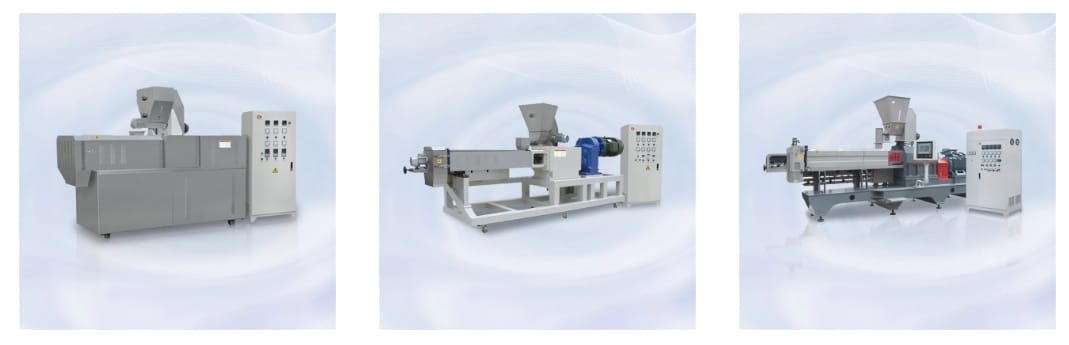
This is the most common industrial method. A screw-type extruder is used. The prepared dough is fed into the extruder where it is subjected to:
-
- High Pressure: The screw(s) convey, compress, and shear the dough.
-
- High Temperature: Frictional heat and external heating raise the temperature to between 120°C and 175°C.
The superheated, pressurized dough is then forced through a die at the end of the extruder. The instant it exits the die, it encounters atmospheric pressure, causing the superheated water to flash off into steam. This rapid pressure drop expands the product, creating its characteristic light and airy structure. The shape of the die determines the final shape of the snack (e.g., balls, curls, tubes).
- High Temperature: Frictional heat and external heating raise the temperature to between 120°C and 175°C.
2. Frying Puffing (Direct Expansion):
Some products, like cheese puffs, are puffed by direct immersion in hot oil. The high temperature of the oil (180-200°C) rapidly heats the water inside the pellet, causing vaporization and expansion. This method simultaneously puffs and cooks the snack, imparting a distinct fried flavor and a higher fat content.
3. Oven Puffing (Hot Air):
For a lower-fat alternative, some snacks are puffed using hot air. Pre-formed pellets (which have been previously gelatinized and dried) are conveyed through a high-temperature oven. The heat causes the residual moisture to vaporize, puffing the product. This method results in a different texture, often less expansive but with a crispier bite.
E. Drying/Toasting
After puffing, the product may still contain residual moisture that needs to be reduced to achieve the desired crispness and shelf stability. This is done in a multi-zone dryer or toasting oven, which uses circulating hot air to lower the moisture content to a safe level (typically 1-3%).
F. Seasoning Application
The bland, base puffed product is then seasoned. This is typically done in a rotating drum tumbler. Oils or a gum solution are first misted onto the snacks to help the dry seasoning powders adhere. A wide variety of seasonings—cheese, barbecue, sour cream & onion, etc.—are then evenly applied.
G. Cooling and Packaging
The seasoned snacks are cooled to near ambient temperature to prevent condensation inside the packaging, which would lead to sogginess and microbial spoilage. Finally, the product is packaged in moisture-proof and gas-flushed (often with Nitrogen) bags to maintain freshness, crispness, and protect against oxidative rancidity.
3. Quality Control
Throughout the process, critical control points are monitored:
-
- Raw Material Quality: Consistency of the grits/meal.
-
- Moisture Content: Pre- and post-puffing.
-
- Expansion Ratio: The ratio of the volume after puffing to the volume before.
-
- Texture: Measured by texture analyzers to ensure desired crispness (hardness, fracturability).
-
- Color and Flavor: Consistent application and sensory profile.
Leave A Comment