
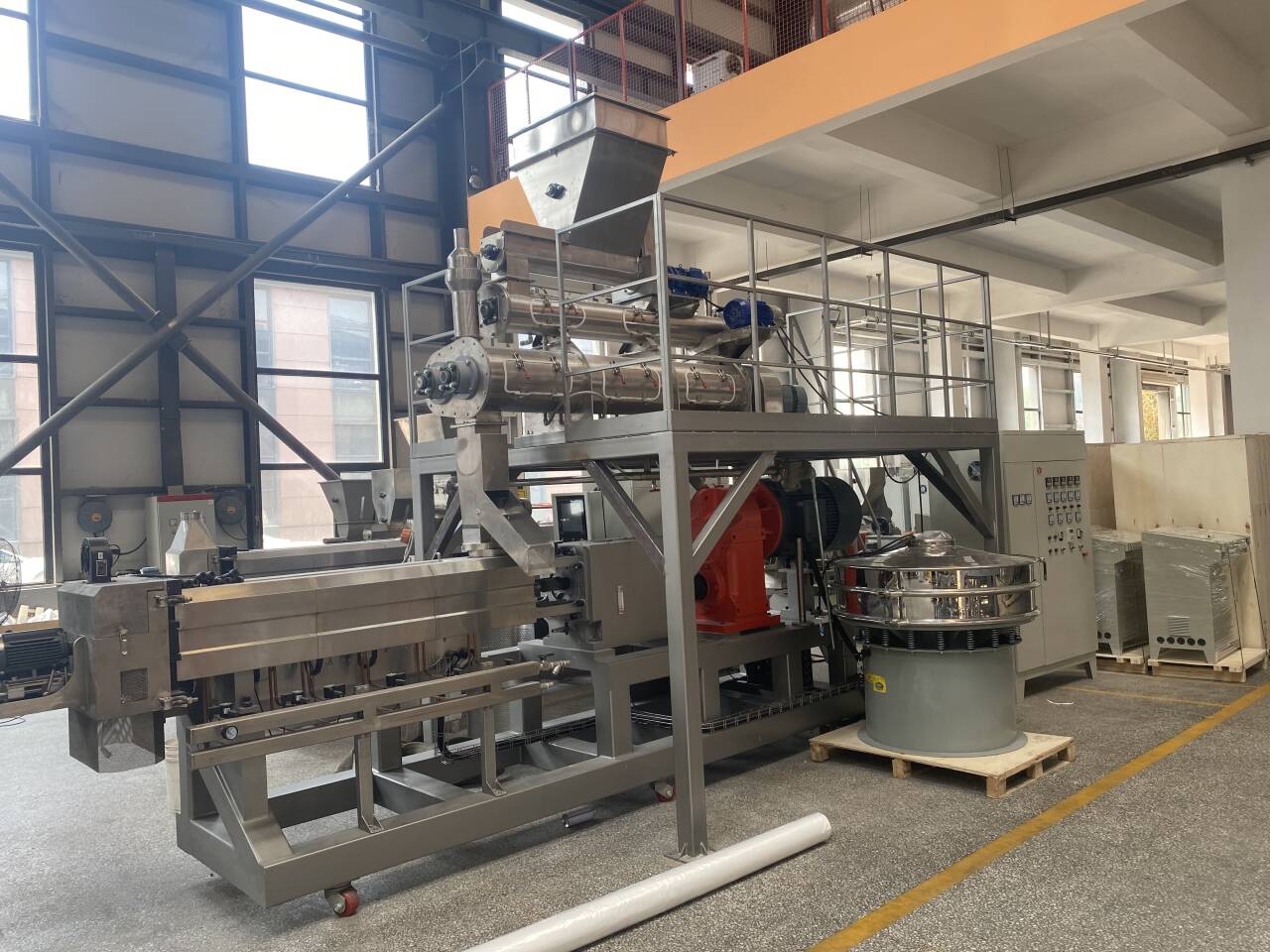
Single-screw and twin-screw extruders are both foundational machines in food, feed, and polymer processing, yet they operate on distinct principles and excel in different applications. extruder machine Choosing the correct type is a critical decision that impacts flexibility, product quality, and process economics. Here is a detailed breakdown of their key differences.
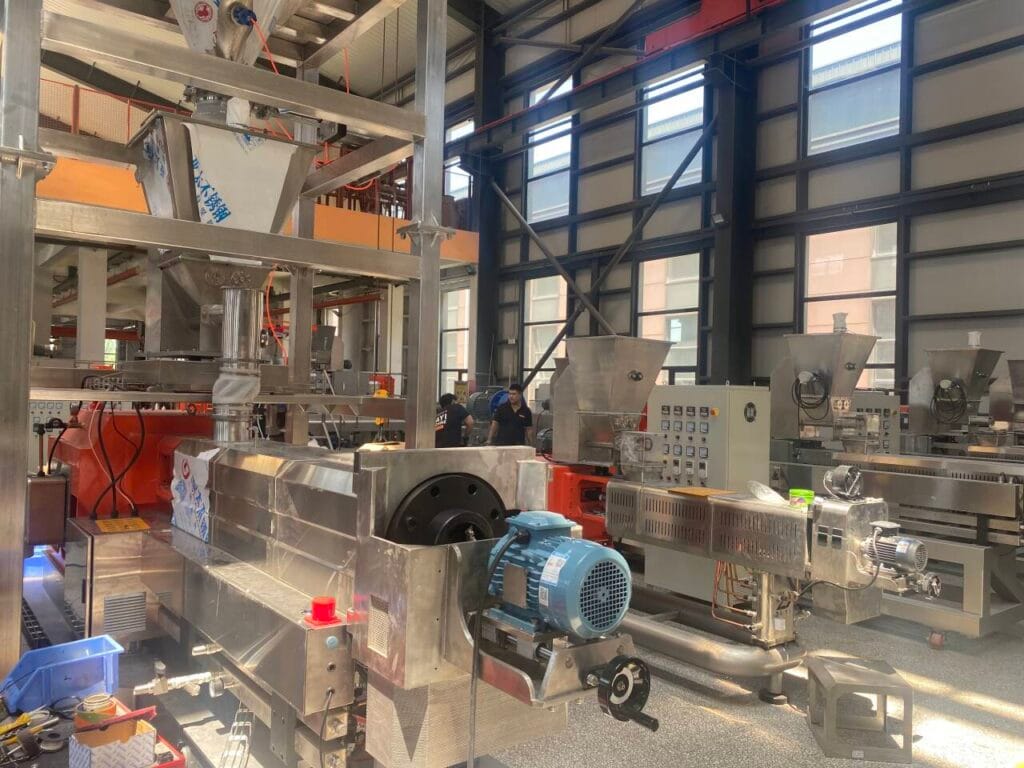
1. Core Mechanical Design & Operation
- Single-Screw Extruder (SSE):
- Design: Features a single solid screw rotating within a stationary, smooth or grooved barrel. Material conveyance relies primarily on the frictional drag between the material, the screw, and the barrel wall.
- Flow Mechanism: Predominantly drag-induced flow. The process is heavily dependent on the material’s intrinsic properties (viscosity, coefficient of friction). extruder machine It operates like a positive-displacement pump only if the friction on the barrel is greater than on the screw.
- Twin-Screw Extruder (TSE):
- Design: Features two parallel screws that intermesh (co-rotating is most common in food) within a figure-eight shaped barrel chamber.
- Flow Mechanism: Principally positive-displacement pumping, like a gear pump. The intermeshing screws create sealed “C-shaped chambers” that convey material forward regardless of its frictional properties. This provides superior control over residence time and pressure.
2. Key Performance Characteristics & Comparison
| Feature | Single-Screw Extruder (SSE) | Twin-Screw Extruder (TSE) |
|---|---|---|
| Mixing Efficiency | Poor to moderate. Primarily distributive mixing. Limited capacity for generating uniform shear. | Excellent. Combines distributive and intensive (dispersive) mixing. Screw elements (kneading blocks, etc.) can be configured for specific shear profiles. |
| Self-Cleaning Action | Poor. Material can stagnate in screw channels, leading to degradation and cross-contamination. | Excellent. The wiping action of the intermeshing screws continuously cleans both the screws and the barrel wall, ensuring a uniform residence time and reducing hang-up. |
| Feed Flexibility | Limited. Requires feed materials with relatively uniform and predictable frictional properties (e.g., cereal grits). Struggles with sticky, oily, very wet, or non-free-flowing powders. | Very High. Can handle a vast range: sticky doughs, high-fat/oil recipes, wet masses, powders, and even fibrous materials without bridging. |
| Process Control | Less precise. Output and energy input are more sensitive to feedstock variations and wear. | High Precision. Independent control over screw speed and feed rate allows precise management of Specific Mechanical Energy (SME) and fill level in the barrel. |
| Energy Input (SME) | Primarily via shear (screw speed) and external heating. Less efficient at converting motor power to uniform SME. | More efficient and controllable SME input. Energy comes from both mechanical shear and conductive heating, with better uniformity. |
| Output Pressure Build-Up | Good for generating high, stable die pressure, but relies on a long, restrictive barrel section. | Can generate high pressure more efficiently using restrictive screw elements or a die plate, independent of barrel length. |
| Capital & Operating Cost | Lower. Simpler design, lower initial investment, and generally lower maintenance costs. | Higher. More complex design with twin drives, gearboxes, and precision parts leads to a higher purchase price and typically higher maintenance costs. |
3. Typical Applications
- Single-Screw Extruders Excel In:
- High-volume, simple products where recipe and raw materials are consistent.
- Direct-expanded snacks (corn puffs, cheese curls).
- Pet food/kibble production (standard formulas).
- Some breakfast cereals.
- Plastics: Film, sheet, and profile extrusion of standard polymers.
- Twin-Screw Extruders Excel In:
- Complex, value-added products requiring precise multi-ingredient mixing.
- Textured Vegetable Protein (TVP) and meat analogs (requiring high shear and specific texturization).
- Co-extrusion and filled products.
- Confectionery (licorice, gum, fruit snacks).
- Pre-conditioned cereals and high-fiber products.
- Reactive extrusion (for chemical modification of starches or proteins).
- Masterbatch and compound production in plastics.
4. Summary: Decision-Making Factors
Choosing between the two often comes down to a trade-off between cost and capability.
- Choose a Single-Screw Extruder if: Your product portfolio is relatively simple, your recipes use consistent, free-flowing raw materials, your primary goal is high-volume, low-cost production, and you do not require frequent recipe changes or ultra-homogeneous mixing.
- Choose a Twin-Screw Extruder if: You require high formulation flexibility, are working with challenging ingredients (sticky, wet, oily), need superior mixing for uniformity, plan frequent product changeovers, or are developing complex textured products like meat alternatives. The investment is justified by reduced waste, faster development cycles, and greater product innovation potential.
In essence, the single-screw extruder is a robust, efficient workhorse for standardized tasks, while the twin-screw extruder is a versatile, precision tool for complex processing and innovation. extruder machine Understanding their fundamental differences is the first step in selecting the right tool for the job.
Leave A Comment