
The Alchemy of Air: Eight Critical Elements for Mastering the Production of High-Quality Puffed Snacks
Puffed snacks occupy a unique and beloved space in the global food market. From the humble cheese curl to the sophisticated multigrain extrudate, puffed snack food making machine their appeal lies in their ethereal texture, intense flavor delivery, and crave-inducing mouthfeel. However, achieving a consistent, high-quality puffed product is a complex feat of food engineering and chemistry, far removed from the simple perception of these items as “junk food.” The transformation of dense, raw ingredients into a light, porous structure is a delicate alchemy governed by precise control over a multitude of variables. This article delineates and explores the eight fundamental elements crucial for success in this domain: Raw Material Selection and Functionality, The Science of the Extrusion Process, Moisture Content Management, The Critical Role of Frying or Baking, Flavor Adhesion and Delivery, The Paramount Importance of Texture, Packaging Integrity and Shelf-Life Stability, and Quality Assurance and Control from Raw Material to Finished Product. A deep understanding of these interconnected pillars is essential for any enterprise seeking to excel in the competitive and ever-evolving puffed snacks industry.
1. Raw Material Selection and Functionality: The Foundation of Structure and Flavor
The journey to a perfect puffed snack begins not in the extruder, but in the selection and understanding of the raw materials. The chemical and physical properties of the primary ingredients dictate the behavior of the melt during extrusion, the final texture, the nutritional profile, and the base flavor. There is no “one-size-fits-all” formula; the choice is a strategic decision based on the desired product.
1.1 The Star of the Show: Starch Selection and Its Properties
Starch is the primary structural component of most puffed snacks. It is the polymer that, when subjected to heat, pressure, and shear, puffed snack food making machine undergoes gelatinization and forms the malleable melt that can be puffed into a porous structure.
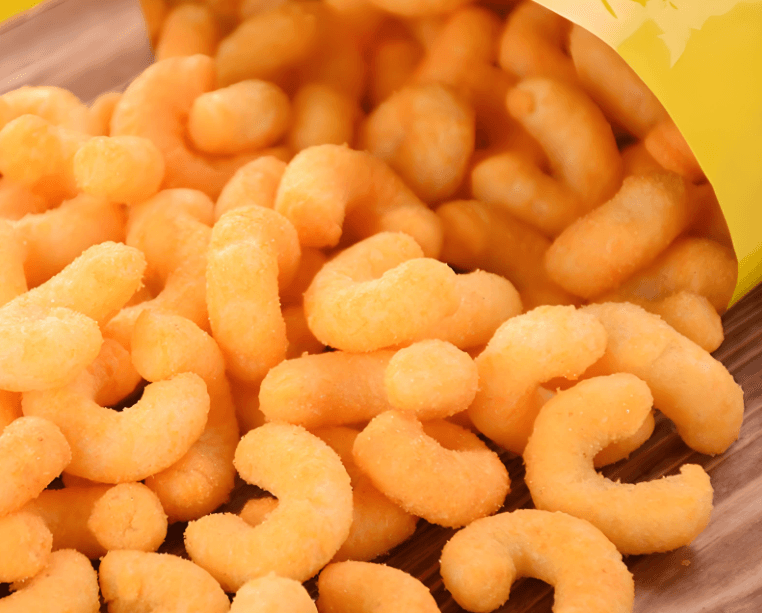
- Corn Meal/Grits: The workhorse of the industry, particularly for products like cheese puffs and direct-expanded corn curls. The type of corn is critical. Yellow corn meal provides a characteristic flavor and color, while white corn meal offers a neutral backdrop for delicate flavors. The particle size of the meal is paramount. A fine, uniform grind ensures consistent water absorption and a smooth melt, leading to uniform expansion and a fine, tender texture. Coarse particles can create weak points, leading to irregular expansion, hard specks, and increased wear on the extruder barrel and screws.
- Rice Flour: Rice is renowned for its ability to expand to a very low density, creating extremely light and crisp textures. It has a very bland flavor, making it an excellent carrier for added flavors. Its low lipid content contributes to a white color and reduced risk of rancidity. It is often used in baby snacks, rice cakes, and as a component in blends to increase crispiness.
- Potato Flakes/Flour: Potato-based snacks offer a distinct, hearty flavor and a unique melt-in-the-mouth texture. The quality of the potato flakes is critical; they must be able to rehydrate and form a cohesive dough. Overcooked or damaged flakes will not provide the necessary viscosity for optimal expansion.
- Wheat Flour: Wheat contributes gluten, a protein network that can provide chewiness and structure. In fully puffed snacks, high gluten content can be detrimental, as it creates a tough, chewy texture rather than a light, crisp one. However, it is useful in co-extruded snacks where a tougher outer shell is needed to contain a filling.
- Tapioca and Other Native Starches: These are often used as modifiers in starch blends. Tapioca starch, for instance, can impart a pleasant chewiness and a clear, shiny appearance. It contributes to a clean flavor and excellent expansion properties.
The ratio of amylose to amylopectin within the starch is a critical molecular-level consideration. High-amylose starches (e.g., from certain corn hybrids) tend to form stronger, puffed snack food making machine more resilient films upon gelatinization, resulting in a harder, denser, and more shatter-resistant puff. High-amylopectin starches (waxy varieties) create a more tender, crispy, but fragile structure that dissolves quickly in the mouth. Most puffed snacks use a balance, but the formulation can be tweaked towards one end of this spectrum depending on the desired texture.
1.2 The Role of Proteins, Lipids, and Fiber
While starch is the primary builder, other components play crucial supporting and often complicating roles.
- Proteins: Sources like soy protein, whey, or dairy powders can be added for nutritional fortification. However, proteins interfere with the starch matrix. They can disrupt the continuous starch phase, acting as points of weakness that limit expansion and can lead to a tougher, less uniform cell structure. High-protein formulations require careful adjustment of process parameters to achieve acceptable puffing.
- Lipids (Fats and Oils): Fats act as lubricants within the extruder barrel. Adding 1-2% of an oil (like corn or canola) to the dry mix can reduce mechanical energy input, puffed snack food making machine lower melt viscosity, and reduce wear on the equipment. However, as with proteins, they interfere with the starch matrix. High lipid content (>5-6%) can severely inhibit expansion by coating starch granules and preventing them from hydrating and forming a continuous melt. The result is a dense, greasy, and non-puffed product. Furthermore, lipids are highly susceptible to oxidative rancidity, which is a primary cause of shelf-life failure.
- Dietary Fiber: Ingredients like oat fiber, bran, or inulin are added to boost the fiber content. Similar to proteins, fiber particles can puncture and weaken the starch bubble walls during expansion. This typically results in a denser product with a less uniform, more “crunchy” than “crispy” texture. Formulations high in fiber require significant process optimization and often the use of specialized ingredients like soluble fibers that can integrate more seamlessly into the melt.
1.3 Water: The Plasticizer and blowing Agent Precursor
Water is not merely an ingredient; it is the primary plasticizer and the agent of puffing. The moisture content of the pre-mix, typically between 12-16% for direct expansion extrusion, controls the rheology of the melt. It lowers the glass transition temperature of the starch, allowing it to become plastic and flowable under heat and shear. More importantly, upon exit from the die, this superheated water instantly flashes into steam, providing the force for expansion. Consistency in the moisture content of the raw materials and the precision of water injection during preconditioning and extrusion are, therefore, non-negotiable for product consistency.
In essence, the selection of raw materials is a foundational science. The formulator must understand not just the chemical composition of each ingredient, but also its functional properties—how it hydrates, gelatinizes, shears, and interacts with other components under the extreme conditions of the extrusion process.
2. The Science of the Extrusion Process: Where Transformation Occurs
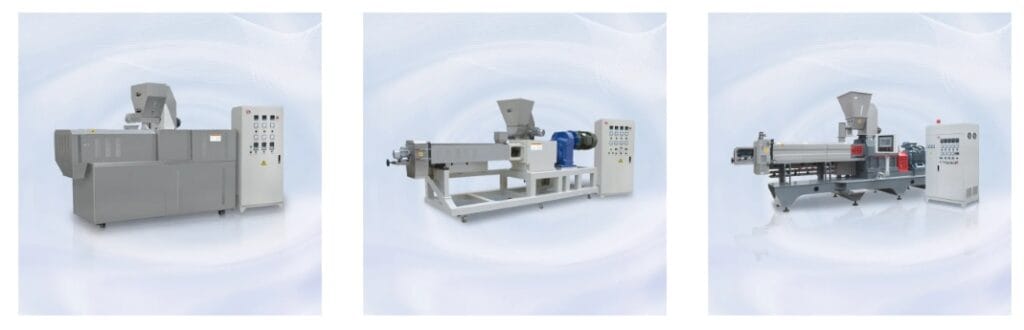
Extrusion cooking is the heart of puffed snack manufacturing. It is a high-temperature, short-time (HTST) process that continuously mixes, cooks, shears, and shapes the raw material blend into the final puffed form. Mastering extrusion is about controlling the interplay of mechanical energy, thermal energy, and moisture.
2.1 The Extruder as a Biochemical Reactor
A twin-screw extruder is the industry standard for its superior mixing, pumping, and self-cleaning capabilities. The process within the barrel can be conceptually divided into several zones:
- Feed Zone: Dry ingredients are introduced and mixed.
- Pre-conditioning/Mixing Zone: Water and/or steam are injected. The screws, configured with conveying elements, begin to mix the ingredients into a damp, crumbly mass.
- Compression and Cooking Zone: This is where the magic happens. The screw configuration shifts to kneading blocks and restrictive elements. These create intense shear and pressure, mechanically working the dough. The combination of this mechanical energy and external heating from the barrel jackets raises the temperature to between 120°C and 180°C. At this stage, starch granules swell, rupture, and lose their crystalline structure in a process called gelatinization. The mixture is transformed from a particulate dough into a viscous, homogeneous, plasticized “melt.”
- Metering Zone: The fully cooked melt is pushed under high pressure (often 500-2000 psi) towards the die.
- Die Assembly and Expansion: This is the moment of truth. The die provides a sudden, calibrated pressure drop. As the superheated melt exits the die into ambient pressure, the superheated water within it (which was kept in a liquid state only by the high pressure) instantly vaporizes into steam. This rapid expansion “inflates” the plastic starch matrix, creating a foam. The foam then sets into a solid, porous structure as it cools and moisture evaporates. The shape of the die dictates the shape of the final product (e.g., circles for puffs, ovals for curls).
2.2 The Critical Process Parameters: The “Golden Triangle” of Extrusion
Three parameters are the primary levers for controlling product characteristics: Moisture, Temperature, and Shear.
- Moisture Content: This is the most influential variable. Lower moisture in the melt (e.g., 12-14%) results in higher viscosity, higher mechanical energy input, and higher product temperature. This typically leads to greater expansion and a very light, crispy texture. Higher moisture (e.g., 16-20%) plasticizes the melt more, reducing viscosity and energy input, resulting in less expansion and a denser, harder bite.
- Barrel Temperature Profile: Temperature controls the degree of cooking. Insufficient temperature leads to incomplete gelatinization, resulting in a raw flavor, poor expansion, and a weak, powdery texture. Excessive temperature can cause burning, discoloration, and the degradation of heat-sensitive nutrients and flavors. A staged temperature profile is used, often starting lower to build pressure and increasing towards the end to ensure full cook.
- Shear Force: Controlled by screw speed (RPM) and screw configuration. Shear is essential for thorough mixing, heat transfer, and the mechanical breakdown of starch granules. High shear promotes a more uniform melt and can enhance expansion. However, excessive shear can mechanically degrade the starch polymers, breaking them down into smaller chains (dextrinization), which weakens the cell walls and produces a fragile, easily shattered product with a lower bulk density.
2.3 Die Design and Its Profound Impact
The die is not just a shape-giving tool; it is a critical texturizing element. The length-to-diameter (L/D) ratio of the die channel determines the back-pressure upstream. A long, restrictive die creates high back-pressure, leading to more thorough cooking and a denser, puffed snack food making machine more textured product. A short, open die allows for rapid expansion. The design of the die face itself—whether it is a simple round hole or a complex multi-layered plate for co-extrusion—is a specialized field of food engineering that directly impacts product appearance, texture, and structural integrity.
The extrusion process, therefore, is a continuous balancing act. The operator must manipulate feed rate, moisture injection, barrel temperatures, and screw speed in a coordinated manner to direct the physicochemical transformations of the raw materials, transforming a dense powder into a light, airy, and structured snack.
3. Moisture Content Management: The Invisible Architect of Texture
Moisture is the invisible architect that governs the entire lifecycle of a puffed snack, from its transformation in the extruder to its crispness on the tongue and its stability on the shelf. Its management is a continuous process from raw material to packaging.
3.1 Pre-Extrusion: Consistency is King
Variability in the moisture content of incoming raw materials is a primary source of process instability. A batch of corn meal at 13% moisture will behave very differently from a batch at 11% moisture, even if all other extrusion parameters are held constant. This can lead to erratic expansion, variable bulk density, and inconsistent color. Therefore,puffed snack food making machine raw material specifications must include tight moisture tolerances, and storage in a controlled environment is essential.
3.2 The Pivotal Role in Expansion
As established, the moisture within the melt is the blowing agent. The precise amount of water, uniformly distributed throughout the melt, determines the potential energy available for expansion. An optimal level creates a fine, uniform cell structure. Too little moisture results in insufficient steam generation, leading to poor expansion and a hard, dense product. Too much moisture creates large, irregular steam pockets, resulting in a coarse, open cell structure that can be fragile and have a soggy mouthfeel.
3.3 Post-Extrusion: The Quest for the Perfect “Bite”
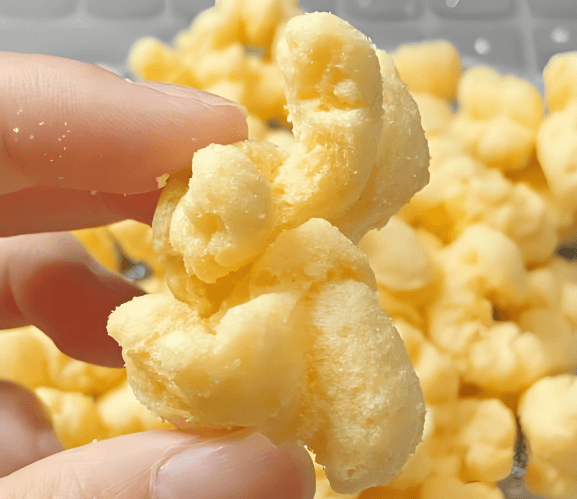
The moisture content of the puffed extrudate as it exits the die is still relatively high (e.g., 8-10%). At this level, the product is leathery and chewy, not crisp. Crispness is a textural property associated with a rigid, solid foam that fractures easily. This state is only achieved when the moisture content is reduced to a very low level, typically between 1% and 3%. At this low water activity, the starch and other biopolymers are in a glassy state, meaning they are hard and brittle.
3.4 The Drying and Toasting Step
After extrusion, the products are conveyed through a multi-pass dryer/toaster oven. This step serves two purposes:
- Moisture Reduction: Hot, dry air circulates around the puffs, evaporating the internal moisture to achieve the target of 1-3%. The temperature and time profile must be carefully controlled. Too rapid drying can cause case-hardening, where the exterior becomes hard and glassy, trapping moisture inside. This internal moisture can later migrate out, causing the snack to become stale and lose its crispness.
- Color and Flavor Development: The gentle heat of the toasting oven promotes Maillard reactions and caramelization on the surface of the snack, developing a pleasing golden-brown color and a base of toasted, nutty flavors that form the foundation for the added seasonings.
Achieving and maintaining this perfect, low moisture content from the end of the dryer to the moment the package is sealed is the single most important factor for delivering the satisfying “crisp” that consumers desire.
4. The Critical Role of Frying or Baking: The Final Texturizing Step
While many puffed snacks are “half-products” that are expanded and dried, a significant segment, like cheese puffs and certain curls, undergo a second cooking step: frying or baking. This process is distinct from the initial extrusion and is critical for developing the final texture and flavor.
4.1 Frying: The Path to Ultimate Richness and Crispness
Frying involves submerging the extruded product in hot oil (typically 160-190°C) for a short period, usually 20-60 seconds.
- Texture Transformation: Frying provides an intense, rapid heat transfer that drives off the remaining internal moisture very effectively, creating an exceptionally crisp and rigid structure. The oil penetrates the porous network, replacing some of the air and water. This deposited fat contributes to a rich mouthfeel and a characteristic “melt-away” quality as it warms on the tongue.
- Flavor Delivery: The oil itself acts as a flavor carrier. The choice of oil—whether neutral (like palm or sunflower) or flavorful (like coconut)—imparts a base note. Furthermore, frying catalyzes Maillard reactions on the product’s surface, creating complex, savory flavor compounds.
- The Downside: Frying adds a significant amount of fat to the product (often 20-35% by weight), which is a major concern for health-conscious consumers. It also introduces the risk of oil degradation. As the oil is used continuously, it breaks down through hydrolysis and oxidation, leading to the development of off-flavors (rancidity) and the production of polar compounds that can affect the frying performance and safety of the oil.
4.2 Baking: The Leaner Alternative
Baking is used as a lower-fat alternative to frying. The puffed extrudate is passed through an oven where hot air is used to dehydrate and crisp the product.
- Textural Differences: Baked snacks almost always have a different texture than their fried counterparts. Without the lubricating and structure-modifying effect of penetrating oil, the starch matrix remains more rigid. The result is often a harder, crunchier, and more shattering crispness, lacking the rich mouthfeel and rapid melt-away of a fried snack. They can also have a drier, more powdery surface, which can challenge flavor adhesion.
- Nutritional and Labeling Advantages: Baked products have a clear marketing advantage, with fat contents often below 10% and sometimes as low as 2-3%. This aligns with consumer demand for “better-for-you” options.
- Technical Challenges: Achieving uniform heating and moisture removal in an oven can be more challenging than in a fryer, potentially leading to more breakage and a less consistent product.
The choice between frying and baking is a fundamental strategic decision, trading off the superior sensory properties of frying against the healthier profile and cleaner label potential of baking.
5. Flavor Adhesion and Delivery: The Art and Science of Taste
A puffed snack with perfect texture is a failure if the flavor falls off or is unbalanced. The application of seasonings is a science in itself, crucial for ensuring that the flavor experience matches the textural promise.
5.1 The Canvas: Oil and Moisture as Adhesion Agents
The dry, porous surface of a puffed snack is inherently non-sticky. To make seasonings adhere, an adhesive base must be applied first. This is almost always a liquid oil.
- The Oiling Drum: After toasting or frying, the warm snacks enter a rotating drum. A fine mist of oil is sprayed onto the tumbling product. The oil seeps into the pores and crevices of the snack, creating a tacky surface. The temperature of the snack is critical; a warm product will have lower oil viscosity, allowing for better penetration and distribution.
- The Role of Oil Type: The choice of oil affects flavor release and stability. Oils with a distinct flavor, like butter oil or coconut oil, can contribute to the overall flavor profile. However, highly unsaturated oils (like soybean or canola) are more prone to oxidative rancidity and must be handled carefully.
5.2 The Seasoning Blends: A Symphony of Ingredients
The seasoning mix, which is added immediately after the oil in the tumbling drum, is a complex blend designed for taste, adhesion, and stability.
- Salt (Sodium Chloride): The fundamental flavor enhancer. The particle size of the salt is critical. Fine salt provides immediate impact but can taste harsh, while flake salt provides a burst of salinity and better adhesion.
- Flavor Carriers: Ingredients like maltodextrin, whey powder, or yeast extract are used as a base to carry volatile flavor compounds and to help distribute fine particles evenly.
- Spices and Herbs: These provide the characterizing flavors—cheese, barbecue, sour cream & onion, etc. They can be in powdered form or as oleoresins (oil-soluble extracts) that are plated onto a carrier.
- Acids: Citric acid, lactic acid, or vinegar powder provide the sharp, tangy notes essential for many savory profiles.
- Sweeteners: Sugar or dextrose are often used in small amounts to round out savory flavors and balance acidity.
- Glutamates and Nucleotides: Yeast extract, monosodium glutamate (MSG), and nucleotides (I+G) are powerful umami enhancers that amplify savory notes and create a more satisfying, mouth-watering sensation.
- Anti-Caking Agents: Silicon dioxide or tricalcium phosphate are added to the seasoning blend itself to prevent clumping and ensure a free-flowing powder that can be applied evenly.
5.3 The Challenge of Even Distribution
The tumbling action of the seasoning drum must be perfectly calibrated. Too little tumbling results in uneven coating; too much can cause physical damage and generate fines (small broken pieces). The fines then absorb a disproportionate amount of seasoning and oil, leading to an overly seasoned, oily fines fraction and a bland main product. Modern systems use controlled airflows and gentle baffles to achieve a homogeneous mix with minimal breakage.

Effective flavor delivery is the final sensory payoff. It requires a deep understanding of flavor chemistry, powder technology, and mechanical engineering to ensure that every bite delivers the promised taste experience.
6. The Paramount Importance of Texture: A Multisensory Experience
Texture is arguably the defining characteristic of a puffed snack. It is a multisensory experience perceived through sound (the “crunch”), tactile feel in the hand, and mouthfeel during chewing. It can be broken down into several key attributes.
6.1 Crispness and Crunch: The Sonic Signature
Crispness is the perception of a rigid material that fractures suddenly, cleanly, and with an audible sound when subjected to a biting force. As discussed, this is a direct result of the product being in a glassy state due to its very low moisture content. The cell structure—the size, shape, and thickness of the air cell walls—determines the specific acoustic and fracturing properties. A fine, uniform cell structure produces a high-pitched, sharp “crack,” perceived as crispness. A larger, more irregular cell structure produces a lower-pitched, louder “crunch.”
6.2 Hardness and Densities
Hardness is the force required to achieve a certain deformation (e.g., to bite through the snack). It is closely related to the product’s density (both bulk and piece density). A highly expanded, low-density product will be soft and easy to bite. A less expanded, high-density product will be hard. The target hardness is culturally and product-specific.
6.3 Meltaway and Mouthfeel
This describes how the product breaks down during chewing. A good puffed snack should disintegrate easily, without forming a sticky, doughy bolus in the mouth. This is influenced by the solubility of the starch, the amount and type of fat deposited (fried snacks melt away better), and the presence of other ingredients like protein and fiber, which can create a pasty residue.
6.4 Shelf-Life and Textural Degradation: The Staling Process
The primary enemy of puffed snack texture is moisture migration. If the product is not packaged in a perfect moisture barrier, it will absorb water from the environment. As the moisture content rises from 2% to 5-6%, the biopolymers transition from a glassy to a rubbery state. This loss of glassiness results in a loss of crispness—the snack becomes tough, chewy, and stale. This physical change, known as staling, is a more common cause of failure than microbial spoilage and is a direct function of packaging efficacy.
Understanding and controlling texture requires not just the right process but also the right analytical tools, such as texture analyzers (for hardness) and acoustic sensors, to correlate physical measurements with human sensory perception.
7. Packaging Integrity and Shelf-Life Stability: The Final Guardian
The most perfectly manufactured puffed snack can be ruined by inadequate packaging. The primary role of packaging is to serve as a barrier between the fragile product and its environment, protecting it from its three main enemies: moisture, oxygen, and physical damage.
7.1 The Moisture Barrier: The Most Critical Function
As established, the snack’s crispness depends on its very low water activity. The packaging film must have an extremely low Water Vapor Transmission Rate (WVTR). This is typically achieved using materials like oriented polypropylene (OPP), polyethylene terephthalate (PET), or metallized films. Metallization, where a thin layer of aluminum is deposited onto a plastic film, provides a superb barrier to both moisture and oxygen, and also blocks light, which is a catalyst for oxidation.
7.2 The Oxygen Barrier and Rancidity Prevention
The second major threat is oxygen, which causes the oxidative rancidity of lipids. Even in snacks with low fat content, the small amount of oil present, both in the base and from the seasoning process, is susceptible. This leads to off-flavors and odors described as “painty,” “cardboard,” or “rancid.” Packaging films with a low Oxygen Transmission Rate (OTR), such as those incorporating polyvinylidene chloride (PVDC) or ethylene vinyl alcohol (EVOH) layers, are used to combat this.
7.3 Nitrogen Flushing: The Industry Standard
To further protect against oxidation and physical crushing, the industry universally employs nitrogen flushing. Before sealing, the air inside the bag is displaced with pure nitrogen gas, an inert gas. This achieves two things:
- Removes Oxygen: It drastically reduces the oxygen concentration in the package headspace from 21% to often less than 2%, dramatically slowing down oxidative rancidity.
- Provides Cushioning: The pressurized nitrogen gas inside the bag acts as a cushion, protecting the fragile puffs from being crushed during handling, shipping, and stacking on store shelves. The “pillow” of gas is a deliberate and essential feature.
7.4 Light Blocking and Sustainability Challenges
Light, particularly UV light, can accelerate both rancidity and color fading. Opaque or metallized films provide excellent light protection. A major contemporary challenge is the development of sustainable packaging that maintains these high barrier properties. Monolayer films are easier to recycle but often have inferior barrier properties compared to multi-layer laminates, which are difficult to recycle. This is a major area of R&D for the industry, exploring bio-based polymers and advanced recycling technologies.
Packaging is the final, crucial step in the quality chain. A failure in the packaging barrier will nullify all the careful work done in ingredient selection, extrusion, and flavoring, leading to a stale, rancid, or crushed product that disappoints the consumer and damages the brand.
8. Quality Assurance and Control: The Unbroken Chain of Vigilance
Quality cannot be inspected into a product; it must be built into the process from the beginning. A robust Quality Assurance (QA) and Quality Control (QC) system is the framework that ensures consistency, safety, and adherence to specifications at every single stage.
8.1 Incoming Raw Material Inspection (QC)
Every batch of raw material must be tested against strict specifications before being approved for use. Key tests include:
- Moisture Content: Using a loss-on-drying or Karl Fischer method.
- Particle Size Distribution: Using a series of sieves or a laser diffraction analyzer.
- Microbiological Load: Testing for total plate count, yeast, mold, and pathogens like Salmonella.
- Functionality Tests: For starches, tests like viscosity using a Rapid Visco Analyzer (RVA) can predict performance.
8.2 In-Process Control (QC)
During production, continuous monitoring is essential to catch deviations in real-time.
- Extrusion Parameters: Constant monitoring of die pressure, melt temperature, motor amperage, and screw speed.
- Moisture Analysis: Near-infrared (NIR) sensors can be used online to monitor moisture post-drying and post-seasoning.
- Frying Oil Quality: Continuous monitoring of Free Fatty Acid (FFA) content and total polar compounds to determine when the oil needs to be discarded or refreshed.
- Color and Size: Machine vision systems can automatically inspect products for consistent color and size, rejecting off-spec pieces.
8.3 Finished Product Testing (QC)
The final product is tested to ensure it meets all quality attributes before release.
- Sensory Evaluation: A trained panel evaluates appearance, aroma, flavor, and texture.
- Instrumental Texture Analysis: A texture analyzer measures hardness and fracturability.
- Bulk Density: A simple but critical test for expansion consistency.
- Moisture and Water Activity (aw): Confirming the product is within the specified low range (e.g., aw < 0.3).
- Package Integrity: Testing for seal strength and verifying the oxygen content in the headspace is within limits.
8.4 The HACCP Plan and Food Safety (QA)
A Hazard Analysis and Critical Control Points (HACCP) plan is a mandatory, systematic preventive approach to food safety. It identifies potential biological, chemical, and physical hazards and establishes control measures. For puffed snacks, the extrusion process is a Critical Control Point (CCP) where the high temperature is validated to achieve a pathogen kill step. The nitrogen flushing and sealing operation is another CCP for preventing oxidative rancidity. A robust HACCP plan, backed by thorough documentation and verification, is the bedrock of a safe food production system.
A culture of quality, driven by a dedicated QA/QC department with the authority to stop production, is what separates market leaders from the rest. It is the unbroken chain of vigilance that turns a good manufacturing practice into a great one, ensuring that every bag of puffed snacks delivers a safe, consistent, and delightful experience.
The production of high-quality puffed snacks is a remarkable synthesis of food science, mechanical engineering, and sensory art. It is a process where the seemingly simple is, in fact, profoundly complex. The eight elements outlined—Raw Materials, Extrusion, Moisture, Frying/Baking, Flavor, Texture, Packaging, and Quality Control—are not isolated steps but deeply interconnected pillars. A change in the starch source will demand an adjustment in extrusion parameters, which will affect the final texture and the product’s ability to hold seasoning, which in turn must be protected by the right packaging from moisture and oxygen.
The brands that will thrive in the future will be those that master this interconnected system. They will leverage a deep scientific understanding to innovate with new, healthier ingredients and more sustainable processes, all while maintaining the irresistible texture and explosive flavor that define the very essence of a puffed snack. The journey from a handful of raw powder to a bag of light, crispy, flavorful puffs is a testament to human ingenuity—a true alchemy of air, where science transforms the ordinary into a product of joy and crave-worthy delight.
Leave A Comment