
The Six Pillars of Puffed Perfection: A Technical Breakdown of the Cheetos Extrusion Process
The creation of Cheetos, those iconic, cheesy, and irresistibly puffed snacks, Kurkure making machine is a marvel of modern food engineering. At the heart of this transformation lies a machine that is both simple in principle and complex in its execution: the snack food extruder. Often called a “puffing gun,” this apparatus performs a kind of culinary alchemy, turning a bland mixture of cornmeal and water into the light, airy, and uniquely shaped puffs that define the brand. Achieving the perfect texture—a delicate crunch that dissolves almost instantly in the mouth—requires meticulous control over every aspect of the extrusion process.
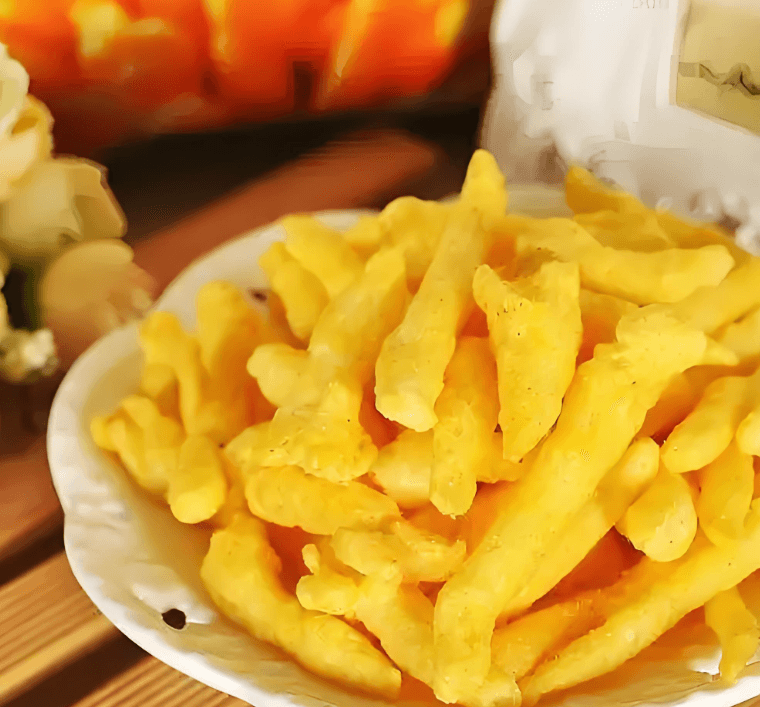
The journey from raw grain to finished Cheetos is governed by six fundamental elements: 1. Raw Material Preparation and Recipe Formulation, 2. The Extrusion Cooking Process, 3. Die Design and Shape Formation, 4. The Cutting Mechanism, 5. Moisture Management and Drying, and 6. The Seasoning Application System. A failure in any one of these pillars can result in a product that is too dense, too hard, improperly shaped, or inconsistently flavored. Kurkure making machine This article will provide a detailed exploration of each of these critical components.
Pillar 1: Raw Material Preparation and Recipe Formulation: The Foundation of Flavor and Texture
The quality of the final product is inextricably linked to the quality and composition of its raw ingredients. For Cheetos, the primary ingredient is corn, but not just any corn will do.
1.1. The Science of Corn Selection and Milling:
The characteristic flavor and golden color of Cheetos come from cornmeal. However, the specific type of corn and its processing are crucial.
- Corn Type and Composition: Dent corn, a field corn known for its high starch content and hard kernel, is typically the grain of choice. The starch is the key component; it is the polysaccharide that will gelatinize during extrusion, forming the matrix that traps water vapor and creates the puffed structure.
- The Milling Process: The corn is dry-milled to create cornmeal. The granulation, or particle size, of this meal is a critical control point. A meal that is too coarse will not hydrate evenly, leading to incomplete gelatinization and a gritty, dense final product. A meal that is too fine can become pasty, clog the extruder, and create an undesirable, glassy texture. The ideal cornmeal has a consistent, medium granulation that allows for uniform water absorption and smooth flow through the extruder.
- Recipe Formulation: While cornmeal is the base, the recipe may include other minor ingredients to modify the texture, flavor, or processing characteristics. These can include:
- Water: The single most important “ingredient” after corn. Its precise ratio to the dry mix is paramount.
- Oils/Fats: A small amount of vegetable oil may be added to the mix to act as a lubricant inside the extruder barrel, reducing mechanical wear and preventing the mixture from sticking to the screws and barrel.
- Other Starches: Potato or tapioca starches might be blended in to alter the expansion and mouthfeel.
- Leavening Agents: Small amounts of baking soda or other food-grade chemical leaveners can be incorporated to supplement the natural puffing action, creating a lighter, more uniform cell structure.
1.2. The Critical Role of Pre-Blending and Pre-Conditioning:
Before the mixture even enters the main extruder, it often undergoes a pre-conditioning stage. The cornmeal and other dry ingredients are fed into a mixer where they are blended with hot water and steam. Kurkure making machine This pre-conditioning serves several vital functions:
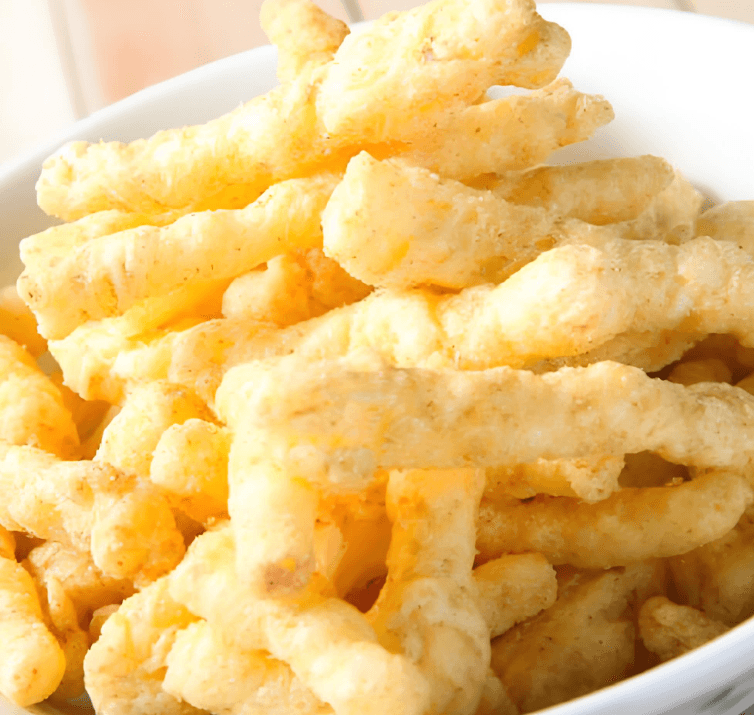
- Initial Hydration: It begins the process of moisture migration into the starch granules, making the subsequent cooking in the extruder more efficient and uniform.
- Partial Gelatinization: The heat from the steam starts to swell the starch granules, beginning the gelatinization process. This reduces the mechanical energy required in the main extruder.
- Temperature Elevation: Bringing the mix up to temperature (often to 70-80°C) before the main extrusion step makes the entire process more stable and controllable.
A well-pre-conditioned mix is consistent and free of dry lumps, ensuring a smooth, stable flow into the extruder and a more predictable final product.
Pillar 2: The Extrusion Cooking Process: The Heart of the Transformation
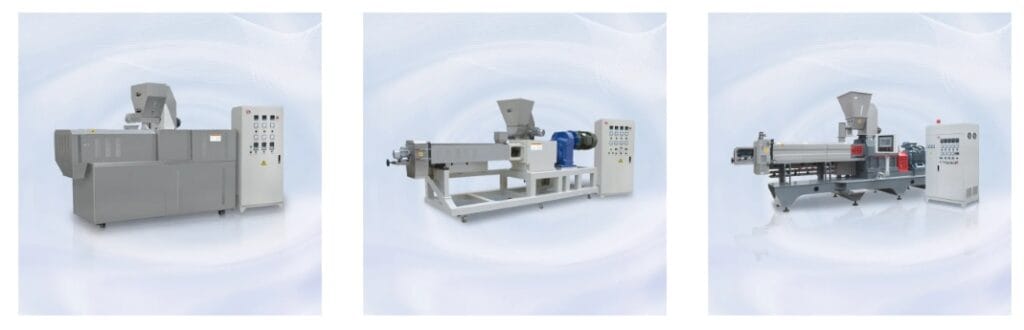
This is where the magic happens. The extrusion cooker is a thermomechanical reactor that uses a combination of heat, pressure, and shear to transform the raw ingredient mix into a hot, plasticized dough. The extruder itself is a long barrel containing one or two intermeshing, screw-shaped shafts.
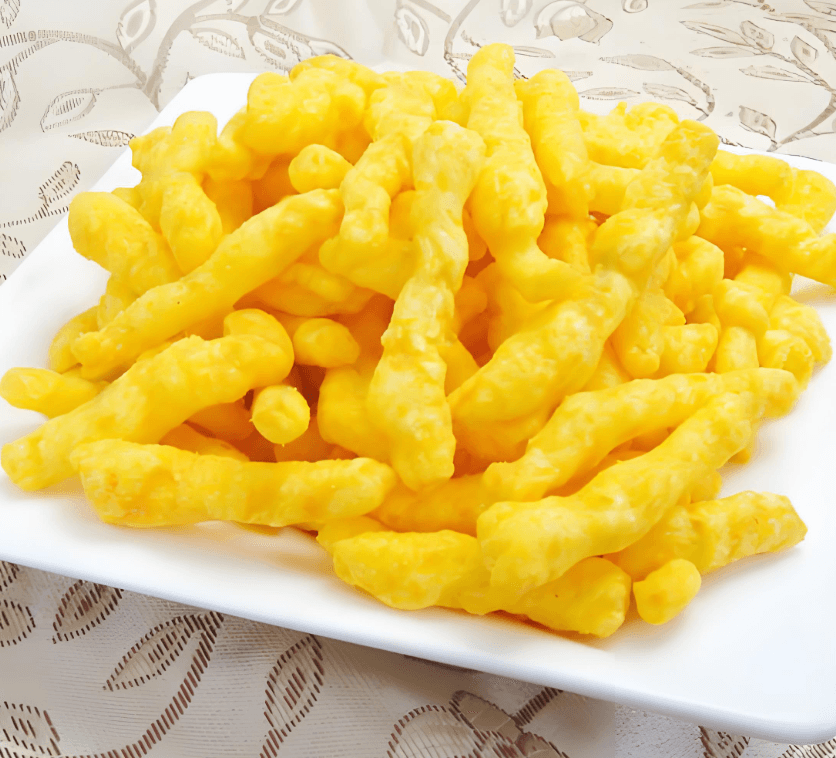
2.1. The Twin-Screw Extruder: The Workhorse of Snack Production:
While single-screw extruders exist, the production of puffed snacks like Cheetos almost exclusively relies on co-rotating twin-screw extruders. Their design offers superior control and mixing capabilities.
- Modular Design: The screws are not one single piece but are assembled from individual elements (kneading blocks, forward conveyors, reverse conveyors) threaded onto a shaft. This allows engineers to “tune” the screw configuration for a specific product. For example, a series of kneading blocks can be placed in the cooking zone to generate high shear and ensure complete starch gelatinization.
- Precise Temperature Control: The extruder barrel is divided into multiple zones, each with independent temperature control, often using electrical heater bands and water-cooling jackets. This allows for the creation of a precise thermal profile. The initial zones might be set to a lower temperature to ensure proper feeding and conveying, while subsequent zones are heated to high temperatures (often 150-180°C) to cook the dough thoroughly.
2.2. The Physics of Starch Gelatinization and Superheating:
As the moistened cornmeal is conveyed down the barrel, it is subjected to immense mechanical shear from the rotating screws and conductive heat from the barrel walls. This combination causes the starch granules to absorb water, swell, and eventually rupture. The long, complex starch chains unravel and form a continuous, viscous, gelatinized matrix. This process is essential for creating the structure that will later puff.
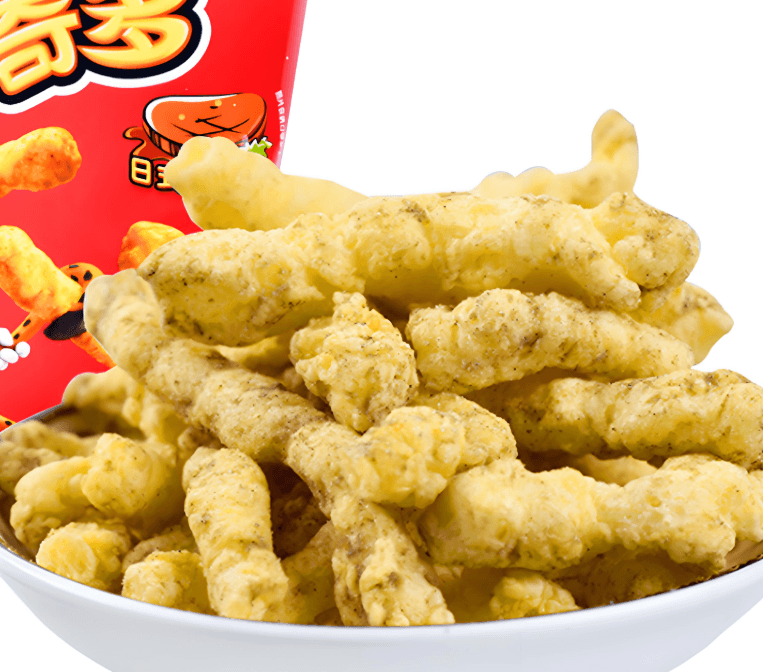
Simultaneously, the water in the mix is heated far above its boiling point at atmospheric pressure. However, because the extruder barrel is a sealed, high-pressure environment (reaching pressures of 20-50 bar or 300-700 psi), the water remains in a liquid state. This superheated water becomes the driving force for the subsequent expansion.
Pillar 3: Die Design and Shape Formation: Creating the Iconic Profile
The die is the final and most defining part of the extruder. It is a specially machined plate, usually made of hardened steel, Kurkure making machine with one or more openings that give the product its characteristic shape.
3.1. The Function of the Die:
The gelatinized, superheated dough is forced under extreme pressure through the die openings. The die has two primary functions:
- Shape Definition: The geometry of the die hole dictates the two-dimensional cross-section of the Cheeto. Whether it’s the classic “cheese puff” shape, a crinkle-cut style, or the more recent crunchy twists, the die is the mold. The design must account for “die swell,” a phenomenon where the elastic dough expands slightly upon exiting the constriction, much like a polymer.
- Pressure Seal: The die provides the final resistance needed to maintain the high pressure inside the extruder barrel, which is essential for keeping the water in a superheated liquid state.
3.2. The Puffing and Expansion Event:
The moment the superheated dough exits the die, it is suddenly exposed to atmospheric pressure. This instantaneous pressure drop causes the superheated water to violently flash into steam. The rapid expansion of this steam inflates the soft, gelatinized starch matrix, creating the porous, foam-like structure that is characteristic of a puffed snack. The entire process—from a dense, hot dough to a light, airy puff—takes milliseconds.
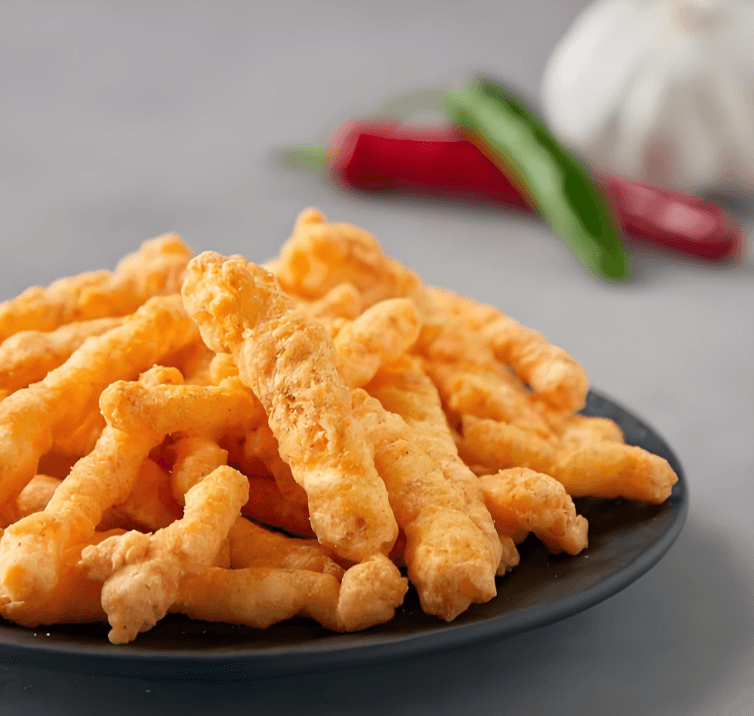
The texture of the final product is determined right here. The size and uniformity of the air cells within the puff are influenced by the dough’s viscosity, temperature, and moisture content as it exits the die. A well-formulated and properly cooked dough will expand uniformly, creating a fine, delicate cell structure that delivers the signature melt-in-your-mouth texture.
Pillar 4: The Cutting Mechanism: Achieving Uniformity
As the continuous, expanding rope of puffed dough emerges from the die, it must be cleanly cut into individual pieces of consistent length. This is the task of the cutting mechanism.
4.1. The Rotary Cutter:
A high-speed rotary cutter is positioned just inches from the die face. It consists of a rotating spindle with several blades that spin at a precisely controlled speed, slicing through the emerging puff.
- Synchronization with Extruder Speed: The speed of the cutter is synchronized with the linear speed of the extrudate (the emerging puff). If the cutter spins too slowly, the pieces will be too long. If it spins too fast, the pieces will be too short and may be crushed or deformed by the blades.
- Blade Design and Sharpness: The blades must be incredibly sharp. A dull blade will tear the soft, hot extrudate rather than making a clean cut, resulting in ragged edges and a significant amount of “fines” or small broken particles. Maintaining blade sharpness is a critical maintenance task to ensure product quality and yield.
The precision of the cutting mechanism ensures that every Cheeto in a bag is a consistent size, which is not only important for aesthetics and consumer expectation but also for the subsequent seasoning step, as it allows for a more even coating.
Pillar 5: Moisture Management and Drying/Toasting: Setting the Structure
The puffed product exiting the die and cutter has the correct shape and internal structure, but its texture is not yet finished. It is soft, pliable, and still has a high moisture content (typically 8-10%). To achieve the desired crispness and shelf stability, this moisture must be reduced.
5.1. The Multi-Zone Dryer/Oven:
The freshly cut, moist puffs are conveyed through a multi-pass or multi-zone dryer, which is often a large, continuous belt oven.
- Moisture Reduction: The primary goal is to gently remove excess moisture, bringing the final water activity (aw) down to a critically low level (typically below 0.3). This low water activity is what makes the product crisp and prevents microbial growth, ensuring a long shelf life.
- Texture Development and Toasting: The drying process does more than just remove water. The controlled application of heat in the oven causes further chemical changes. It sets the starch structure, making it rigid and brittle—thus creating the “crunch.” Additionally, it initiates Maillard browning reactions and other thermal processes that develop the base, toasted corn flavor of the puff before any seasoning is applied. This foundational flavor is essential, as it provides the savory backdrop upon which the cheese and other seasonings are built.
The time and temperature profile in the dryer are carefully controlled. Excessive heat can burn the product or create an overly hard, tooth-breaking texture. Insufficient drying will result in a soggy, stale-tasting puff that is prone to spoilage.
Pillar 6: The Seasoning Application System: The Final Flavorful Embrace
A plain, toasted corn puff is a blank canvas. The final, defining characteristic of a Cheeto—its powerful, tangy, cheesy flavor—is applied after drying. The application of seasoning is a science in itself, requiring precision and consistency.

6.1. The Seasoning Drum:
The dried, cooled puffs are transferred into a large, Kurkure making machine rotating drum, often called a coating reel or tumbler.
- The Tumbling Action: The gentle rotation of the drum causes the puffs to tumble over themselves, creating a continuous, cascading motion. This ensures that each piece is evenly exposed to the seasoning.
- Oil as a Adhesive: Before or during the tumbling, a light mist of vegetable oil is sprayed onto the puffs. This oil acts as a “tackifier” or adhesive. The dry, porous surface of the puff readily absorbs the oil, creating a sticky surface to which the dry seasoning powder can cling.
- Precise Application of Seasoning: The dry seasoning blend—a meticulously formulated powder containing cheese (like cheddar), salt, whey, flavor enhancers (e.g., MSG), and colorants (e.g., paprika extract, annatto)—is then metered into the drum. The tumbling action evenly distributes the fine powder across the oiled surfaces of the puffs.
6.2. The Art and Science of the Blend:
The seasoning blend is a proprietary masterpiece. Its particle size must be fine enough to adhere well but not so fine that it becomes dusty. The ratio of oil to seasoning must be perfect; too little oil and the seasoning falls off, too much oil and the product becomes greasy and the seasoning clumps. The result of a well-tuned system is that iconic, bright orange dust that coats every square millimeter of every puff, delivering that consistent, intense flavor punch with every bite.
The production of a Cheeto is a seamless integration of thermodynamics, fluid mechanics, material science, and culinary art. Each of the six pillars—Raw Material Preparation, Extrusion Cooking, Die Design, Cutting, Drying, and Seasoning—plays an indispensable role. Kurkure making machine They are not sequential steps but interconnected stages in a continuous, precisely controlled process. A variation in moisture content at the beginning will alter the puffing at the die, which will affect the cutting and the final texture after drying, which in turn influences how the seasoning adheres. It is this symphony of controlled elements, working in perfect harmony, that transforms simple cornmeal into one of the world’s most recognizable and beloved snacks.
Leave A Comment