The Eight Pillars of Premium Aquaculture Feed Production: A Comprehensive Guide to Formulation and Manufacturing
The global aquaculture industry stands as one of the most critical and rapidly expanding sectors in the world’s food system. With wild-capture fisheries operating at or beyond their sustainable limits, fish feed making machine aquaculture has emerged as the primary source of seafood for human consumption. At the very heart of this industry lies a single, indispensable component: fish feed. The quality, efficiency, and sustainability of feed directly dictate the health of the farmed fish, the economic viability of the operation, and the environmental footprint of the entire industry.
Producing high-quality fish feed is a discipline that sits at the intersection of marine biology, nutritional science, feed technology, and environmental engineering. It is a far more complex endeavor than producing feed for terrestrial livestock. fish feed making machine Fish are poikilotherms (cold-blooded), live in a buoyant, aqueous environment, and have digestive systems and nutrient requirements that are often species-specific and vastly different from those of land animals. Furthermore, the feed must be physically stable in water to prevent nutrient leaching and water pollution.
This article provides an exhaustive exploration of the eight critical pillars underlying the production of superior fish feed. We will delve into the foundational science of aquatic nutrition, the strategic selection of raw materials, the advanced manufacturing processes of extrusion, fish feed making machine and the rigorous quality control measures that ensure every pellet delivers optimal performance. From the hatchery to the harvest, the journey of a high-quality feed pellet is one of precision, innovation, and an unwavering commitment to excellence.
Pillar 1: Mastering Species-Specific Nutritional Requirements
The most fundamental principle in aquafeed production is that there is no “one-size-fits-all” formula. The nutritional needs of a carnivorous marine fish like a Atlantic salmon are worlds apart from those of an omnivorous freshwater fish like a tilapia or a filter-feeding shrimp. Formulating a successful feed begins with a deep, physiological understanding of the target species.
1.1. The Carnivore-Omnivore-Herbivore Spectrum
- Carnivorous Fish (e.g., Salmon, Trout, Sea Bass, Sea Bream): These species require diets very high in protein (40-55%) and energy, with a significant portion of this protein derived from animal sources. They have a limited ability to utilize high levels of carbohydrates and rely on protein and fat as their primary energy sources. Their requirement for specific amino acids like methionine and lysine is critical, and they need long-chain polyunsaturated fatty acids (LC-PUFAs) like EPA (Eicosapentaenoic acid) and DHA (Docosahexaenoic acid) for proper neural development, immune function, and membrane integrity.
- Omnivorous Fish (e.g., Tilapia, Catfish, Carp): These fish possess a more flexible digestive system, capable of utilizing a wider range of protein sources, including more plant-based proteins. Their protein requirements are lower (28-35%), and they can better tolerate and utilize dietary carbohydrates (20-40%) for energy, which helps to spare protein for growth. While they still require essential fatty acids, their needs can often be met with a combination of marine and plant oils.
- Herbivorous Fish (e.g., Grass Carp, Pacu): These species are adapted to diets high in plant material and complex carbohydrates. They have longer digestive tracts, sometimes with specialized organs for microbial fermentation, allowing them to break down cellulose. Their protein requirements are the lowest among cultured fish.
1.2. Life-Stage Nutrition: From Larval to Broodstock Feeds
Nutritional requirements are not static throughout a fish’s life cycle. A feed must be tailored to the specific physiological demands of each stage.
- Larval Feeds (Starter Feeds): This is the most challenging and critical phase. Fry and larvae have underdeveloped digestive systems and require feed that is extremely digestible, palatable, and nutrient-dense. The particles must be microscopically small (microdiets) and often need to be water-stable. Historically, live feeds (e.g., rotifers, artemia) were used, but the industry is moving towards high-performance formulated microdiets. These require highly refined ingredients, attractants, and often special coatings.
- Grow-Out Feeds: This constitutes the bulk of feed produced. The goal is to maximize growth rate and feed conversion ratio (FCR) while maintaining fish health. The formula is optimized for efficient protein deposition (muscle growth) and energy utilization.
- Broodstock Feeds: Feeds for breeding stock are designed not for rapid growth, but for reproductive performance. They are fortified with specific nutrients that enhance gonad development, egg quality, sperm viability, and larval survival. This often includes elevated levels of vitamins (e.g., Vitamin E, Vitamin C), minerals (selenium, zinc), and specific phospholipids and LC-PUFAs.
1.3. Essential Nutrients: The Building Blocks of Health and Growth
- Amino Acids: Protein is not just about quantity but about the balance of ten essential amino acids (EAAs) that fish cannot synthesize. Lysine and methionine are typically the first limiting amino acids in plant-based diets.fish feed making machine Crystalline amino acids are now commonly added to feeds to create a perfect “amino acid profile” that matches the fish’s requirements, similar to the ideal protein concept in other animals.
- Lipids and Fatty Acids: Fats are the primary energy source in most aquafeeds. Beyond energy, they are crucial for:
- Omega-3 LC-PUFAs (EPA & DHA): Perhaps the most famous nutrients in fish. They are vital for cell membrane fluidity, brain function, immune response, and, in salmonids, they impart the characteristic pink flesh color. The sustainability challenge is to source these from alternatives to wild-caught fish oil, such as algae oil or genetically modified oilseeds.
- Phospholipids: Essential for larval development, aiding in the emulsification and absorption of dietary lipids and as components of cell membranes. Soy lecithin is a common source.
- Carbohydrates: While not essential, carbohydrates are a cost-effective energy source and play a crucial role in extrusion, acting as binders to improve pellet stability.
- Vitamins and Minerals: These are required in precise amounts for metabolic functions. Vitamin C is critical for collagen synthesis and immune function, but it is highly unstable; therefore, coated forms (e.g., ethyl cellulose-coated ascorbic acid) are used. Phosphorus is a key mineral for bone development, but its bioavailability varies greatly depending on the source (e.g., inorganic monocalcium phosphate is highly available, while phytate-bound phosphorus in plants is not).
The Consequence of Neglect: Ignoring species-specific and life-stage needs results in poor growth, low feed efficiency, heightened disease susceptibility, skeletal deformities, poor reproductive performance, and in the case of marine fish, faded flesh color, reducing market value.
Pillar 2: The Strategic Sourcing and Evaluation of Raw Materials
The quality of the final feed is inextricably linked to the quality and suitability of its raw materials. The aquafeed industry is in a constant state of evolution, driven by the need to find sustainable, cost-effective, and high-quality alternatives to traditional ingredients.
2.1. The Protein Source Revolution: Moving Beyond Fishmeal
Fishmeal has been the historical gold standard for aquafeeds due to its excellent amino acid profile, high palatability, and rich content of minerals and unknown growth factors. However, its limited supply and high cost have necessitated a shift.
- Fishmeal Quality Assessment: Not all fishmeals are equal. Quality is determined by the species of fish used, the freshness of the raw material, and the processing conditions. Key quality indicators include protein content (typically 65-72%), ash content (lower is better, indicating less bone), and levels of histamine (an indicator of spoilage).
- Plant-Based Proteins: Soybean meal is the most widely used plant protein due to its consistent supply and good amino acid profile. However, it contains anti-nutritional factors (ANFs) like trypsin inhibitors and antigenic proteins that can damage the fish’s intestinal mucosa. Advanced processing—toasting, fermentation, or enzyme treatment—can mitigate these issues. Other plant proteins include corn gluten meal, rapeseed meal, and pea protein.
- Novel and Alternative Proteins: The search for sustainable proteins is intense. Promising sources include:
- Single-Cell Proteins (SCP): Derived from bacteria, yeasts, or microalgae. They offer a high-protein, low-land-use alternative.
- Insect Meal: Produced from black soldier fly larvae or mealworms, it is a natural protein source for many fish species, rich in protein, fat, and chitin.
- Poultry By-Product Meal: A high-protein ingredient from rendered poultry parts, it is a valuable component, especially in carnivorous fish diets, but quality and consistency can vary.
2.2. The Lipid Source Dilemma: Securing Omega-3s
Similar to the protein challenge, the industry is reducing its reliance on finite fish oil.
- Fish Oil: Remains a prime source of EPA and DHA. Sustainability certifications (e.g., MarinTrust) are increasingly important.
- Vegetable Oils: Oils from soy, rapeseed (canola), and palm are widely used as energy sources. However, they are rich in Omega-6 fatty acids and lack EPA and DHA, leading to an imbalance in the final product’s fatty acid profile if used exclusively.
- Genetically Modified Oils: A breakthrough has been the development of camelina and canola oils genetically modified to produce EPA and DHA, offering a terrestrial, plant-based source of these critical fatty acids.
- Algae Oils: This is the most direct and sustainable solution, as microalgae are the primary producers of EPA and DHA in the marine food web. While currently more expensive, its use is growing, especially in larval and broodstock feeds.
2.3. The Role of Functional Feed Additives
Modern aquafeeds are not just about macronutrients; they are delivery systems for sophisticated additives that enhance performance, health, fish feed making machineand sustainability.
- Phytogenics (Botanicals): Extracts from herbs, spices, and plants (e.g., garlic, oregano, yucca) that can act as appetite stimulants, antimicrobials, and anti-inflammatories.
- Prebiotics and Probiotics: Used to modulate the gut microbiome, improve digestive efficiency, and competitively exclude pathogens.
- Enzymes (e.g., Phytase): Added to break down phytate in plant ingredients, releasing bound phosphorus. This improves mineral availability and reduces phosphorus pollution in the water.
- Mycotoxin Binders: Essential when using plant materials, to prevent the negative effects of fungal toxins on fish health and immunity.
- Pigments: For salmon and trout, synthetic or natural carotenoids (astaxanthin and canthaxanthin) are added to impart the desired flesh color.
The Consequence of Neglect: Poorly sourced or low-quality ingredients lead to inconsistent feed performance, reduced palatability, nutrient deficiencies or imbalances, and the introduction of contaminants (e.g., mycotoxins, dioxins) that compromise fish health and food safety.
Pillar 3: The Science of Feed Formulation and Least-Cost Optimization
Formulation is the intellectual process of translating nutritional requirements into a practical recipe, balancing performance, cost, and physical constraints.
3.1. Moving Beyond Simple Linear Programming
Traditional “least-cost formulation” uses linear programming to create the cheapest mix that meets nutritional constraints. However, premium feed formulation is more nuanced.
- Nutrient-Based Formulation: The focus is on satisfying digestible nutrient requirements (e.g., digestible protein, digestible phosphorus) rather than crude levels, which is more accurate.
- Multi-Objective Optimization: Modern software can balance multiple, sometimes competing, objectives: minimizing cost, minimizing waste output (e.g., phosphorus and nitrogen), and maximizing growth performance or health parameters.
- Use of Nutrient Matrix Values: Instead of using fixed nutrient values for ingredients, formulators use a matrix with upper and lower limits to account for natural variation, ensuring the formula is robust.
3.2. Accounting for Ingredient Interactions and Constraints
A formulator must consider more than just nutrients.
- Palatability: The feed must be eaten. High levels of certain plant proteins can reduce palatability, which may need to be counteracted with attractants like betaine or fish solubles.
- Physical Properties: The formula must be “extrudable.” The levels of starch, fat, and fiber directly influence the pellet’s expansion, density, and durability. A formula that is perfect on paper may be impossible to process.
- Anti-Nutritional Factors (ANFs): The cumulative level of ANFs from various plant ingredients must be kept below tolerance thresholds for the target species.
The Consequence of Neglect: A poorly formulated feed, even with good ingredients, will result in sub-optimal growth, high FCR, nutrient waste, and potential health problems. An over-formulated feed is unnecessarily expensive and wasteful.
Pillar 4: The Advanced Manufacturing Process: The Art of Extrusion
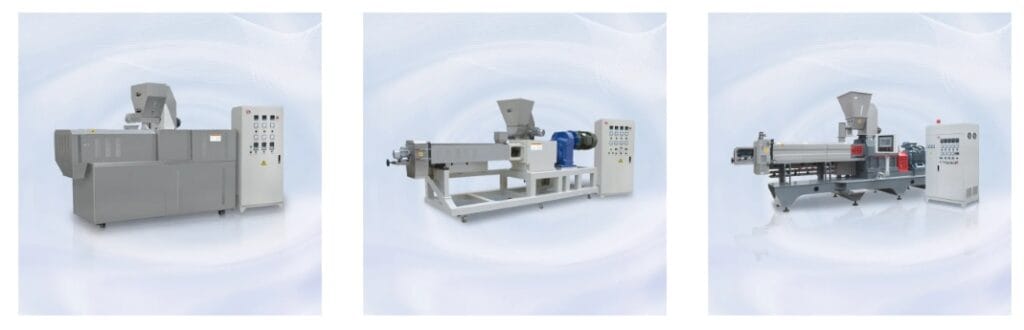
While pelleting is used for some species, extrusion is the dominant and most versatile technology for producing modern aquafeeds. It is a high-temperature, short-time (HTST) process that uses heat, pressure, and shear to cook and shape the feed.
4.1. Pre-Conditioning: The First Step of Cooking
The ground mash is mixed with steam and water in a preconditioner. This hydrates the particles, begins to gelatinize the starch, and heats the mixture, which improves the efficiency of the extruder. Residence time in a modern twin-shaft preconditioner can be several minutes, allowing for substantial pre-cooking.
4.2. The Extruder: The Heart of the Process
The preconditioned dough is conveyed through the extruder barrel by a rotating screw(s).
- Cooking: Friction, pressure, and additional steam injection cook the mixture, typically reaching 120-150°C. This gelatinizes starch (improving digestibility and binding), denatures proteins (improving bioavailability), and destroys pathogens and ANFs.
- Shear and SME: The mechanical shear imparted by the screw is quantified as Specific Mechanical Energy (SME). Controlling SME is critical for controlling starch gelatinization and the final texture of the pellet.
4.3. The Die and Expansion: Creating the Pellet
The cooked, plasticized mass is forced through a die at the end of the barrel.
- Sinking vs. Floating: This is a pivotal control point. The density of the pellet is primarily controlled by the degree of expansion as superheated water flashes into steam upon exit.
- Floating Feed: High expansion, low density. Achieved with high starch, high SME, and low moisture.
- Sinking Feed: Low expansion, high density. Achieved with lower starch, lower SME, higher moisture, and sometimes a vacuum chamber behind the die to suck out air before expansion.
- Shaping: The die holes can be cut to create a vast array of pellet sizes and shapes (cylinders, crumbles, etc.) for different life stages and species.
4.4. Drying and Cooling
The extruded pellets have a high moisture content (~25%) and must be dried to ~10% for stability. Drying is a delicate process in multi-pass dryers; if done too quickly, a hard shell forms, trapping moisture inside and leading to mold. After drying, the pellets are cooled to ambient temperature to prevent condensation in storage.
The Consequence of Neglect: Poor extrusion control results in physically unstable pellets that disintegrate in water, leaching nutrients and polluting the culture system. Incorrect density means the feed is not available where the fish feed (surface, water column, or bottom). Over- or under-cooking reduces nutrient availability.
Pillar 5: Post-Extrusion Technology: Coating and Oil Application
One of the greatest advantages of extrusion is the creation of a porous, dry pellet that can absorb large quantities of oil and other liquid additives.
5.1. Vacuum Coating: The Game Changer
Standard coating in a rotating drum can only add 10-15% oil before the pellet becomes too oily and handling is problematic. Vacuum coating technology revolutionized aquafeed.
- The Process: Dried, cooled pellets are placed in a sealed drum, and a vacuum is drawn. This sucks the air out of the pores of the pellets. The liquid coating (a mix of oil, vitamins, attractants, etc.) is then introduced. When the vacuum is released, the atmospheric pressure forces the liquid deep into the pellet’s core.
- The Benefits:
- High Oil Inclusion: Allows for the production of high-energy feeds with oil levels exceeding 30%.
- Nutrient Protection: Fat-soluble vitamins and other sensitive ingredients are protected within the pellet matrix.
- Reduced Leaching: Nutrients are locked in, dramatically reducing losses to the water.
- Better Palatability: The internal coating enhances flavor throughout the pellet.
The Consequence of Neglect: Without effective post-extrusion coating, it is impossible to produce high-energy feeds necessary for carnivorous species. Surface-applied oils can oxidize rapidly, leach into the water, and provide uneven nutrition.
Pillar 6: Uncompromising Quality Control and Assurance
A proactive, science-based Quality Assurance (QA) system is the guardian of feed quality and safety, operating from raw material intake to finished product dispatch.
6.1. Incoming Raw Material Inspection
Every delivery must be tested against strict specifications. This includes:
- Proximate Analysis: Quick tests for moisture, protein, and fat.
- Microbiological Testing: For Salmonella, total plate count, and molds.
- Contaminant Screening: For mycotoxins, dioxins, and heavy metals.
6.2. In-Process Control and HACCP
The manufacturing process is monitored at Critical Control Points (CCPs) as part of a Hazard Analysis and Critical Control Point (HACCP) plan.
- CCP – Extrusion: Temperature, pressure, and moisture are monitored in real-time to ensure proper cooking.
- CCP – Drying/Cooling: Temperature and time profiles are controlled to achieve target moisture and prevent spoilage.
- CCP – Metal Detection: All finished product passes through a metal detector.
6.3. Finished Product Testing
Before release, pellets are tested for:
- Nutritional Verification: Confirming they meet the guaranteed analysis.
- Physical Quality:
- Durability Index (DI): Measures resistance to breakage during handling.
- Pellet Stability Index (PSI): Measures the pellet’s ability to hold together in water over a specified time, quantifying nutrient leaching.
- Stability Testing: Accelerated shelf-life tests (e.g., active oxygen method) to validate the efficacy of antioxidants and establish the “best before” date.
The Consequence of Neglect: Lax QA leads to inconsistent, unsafe, and ineffective feed. It can result in recalls, economic losses, disease outbreaks in farms, and damage to the brand’s reputation.
Pillar 7: Packaging, Storage, and Supply Chain Integrity
The feed’s journey is not over once it leaves the production line. Proper handling until it reaches the farm is crucial.
7.1. Protective Packaging
Feed is packaged in multi-layer, laminated bags with liners that provide a barrier against oxygen and moisture. For bulk shipments, specially designed containers and trucks are used.
7.2. Storage Conditions
Warehouses must be cool, dry, and well-ventilated. High temperature and humidity are the enemies of feed stability, accelerating rancidity and mold growth. FIFO (First-In, First-Out) inventory management is essential.
7.3. Supply Chain Traceability
A robust system must be in place to trace any batch of feed back to its constituent raw materials and forward to the customer. This is critical for managing any potential recall swiftly and effectively.
The Consequence of Neglect: Poor storage destroys a premium feed. Rancid fat leads to loss of energy, destruction of fat-soluble vitamins, and reduced palatability. Moldy feed can introduce mycotoxins, causing liver damage and immunosuppression.
Pillar 8: Embracing Sustainability and Circular Economy Principles
The modern aquafeed industry cannot ignore its environmental and social responsibilities. Sustainability is now a core driver of innovation.
8.1. Reducing the Fish-In-Fish-Out (FIFO) Ratio
This metric measures the amount of wild fish used to produce one unit of farmed fish. Through the strategic use of alternative proteins and oils, by-products from fisheries, and novel ingredients, the FIFO ratio for species like salmon has dropped dramatically, to below 1.0 for some producers, meaning it is a net producer of fish protein.
8.2. Improving Resource Efficiency
This involves:
- Optimizing FCR: The single most important factor for reducing environmental impact. A lower FCR means less feed is needed to produce a kg of fish, fish feed making machinereducing pressure on all resource inputs.
- Reducing Waste Output: Formulating with highly digestible ingredients and adding enzymes like phytase minimizes the excretion of nitrogen and phosphorus into the environment.
8.3. Sourcing Certified Ingredients
Using ingredients certified by organizations like the Marine Stewardship Council (MSC), MarinTrust, or the Roundtable on Responsible Soy (RTRS) ensures that environmental and social standards are met along the supply chain.
The Consequence of Neglect: An unsustainable feed industry undermines the very premise of aquaculture as a solution to food security. It leads to criticism from NGOs, consumer distrust, and a failure to meet the United Nations Sustainable Development Goals.
The production of high-quality fish feed is a testament to the power of applied science and meticulous engineering. It is a continuous, dynamic process of improvement, driven by the intertwined goals of optimizing animal health, ensuring economic viability, and minimizing environmental impact. The eight pillars—Species-Specific Nutrition, Strategic Sourcing, Scientific Formulation, Advanced Extrusion, Precision Coating, Rigorous Quality Control, Careful Storage, and a Commitment to Sustainability—are not isolated steps but interconnected components of an integrated, holistic system.
A weakness in any single pillar can compromise the entire value chain, from the feed mill to the farm to the consumer’s plate. For feed manufacturers, excellence in these areas is a strategic imperative. For farmers, understanding these principles is key to selecting the right feed and managing their stock effectively. As the global population continues to grow,fish feed making machine the role of aquaculture will only become more critical, and it is the relentless innovation and unwavering quality standards within the aquafeed sector that will enable it to fulfill its promise as a primary source of healthy, sustainable protein for the world.
Leave A Comment