
The Six Pillars of Precision: A Comprehensive Guide to Critical Considerations in Food Extruder Operation
The food extruder stands as a cornerstone of modern food processing, a machine of remarkable versatility that transforms simple powders and grains into a vast array of products—from breakfast cereals and snack puffs to pet kibble and textured vegetable protein. Its operation, however, is far from simple. It represents a complex interplay of thermodynamics, rheology, and mechanical engineering. Operating an extruder is not merely a task of feeding and turning a dial; it is a discipline of balancing numerous variables to achieve a consistent, high-quality product while ensuring safety, efficiency, and equipment longevity.snack extruder machine
This in-depth exploration delves into the six most critical areas that demand unwavering attention during the operation of a food extruder. Mastering these pillars is the difference between a process that runs like a symphony and one that descends into costly chaos. We will move beyond superficial tips and provide a foundational understanding of the “why” behind each operational principle, covering raw material preparation, mechanical configuration, thermal management, process monitoring, safety protocols, and shutdown procedures.snack extruder machine
Pillar 1: The Foundation – Rigorous Raw Material Preparation and Feeding
The performance of an extruder is profoundly dictated by the quality and consistency of its inputs. The adage “garbage in, garbage out” is starkly true. Inconsistent raw materials will lead to an unstable process and an inconsistent final product, no matter how skilled the operator.snack extruder machine
1.1. Particle Size and Distribution: The First Commandment of Uniform Flow
The particle size of the raw material blend is arguably the most critical physical property affecting extrusion.
- The Science Behind It: The extruder screw(s) act as a positive displacement pump. A uniform, fine particle size ensures a consistent bulk density and flow characteristic, known as rheology, into the feed housing. If the particle size is too large or has a wide distribution, it can lead to several problems:
- Segregation: Different sized particles can separate during storage and transport, leading to a non-homogeneous feed entering the extruder. This causes fluctuations in moisture, composition, and ultimately, product texture.
- Poor Hydration: During the conditioning phase, steam and water must penetrate the particles. Large, coarse particles hydrate slower and less completely than fine ones. This results in uneven cooking, where some particles are over-gelatinized while others are still raw. This manifests as dark specks, hard lumps, and variable expansion in the final product.
- Mechanical Wear: Abrasive, large particles (like certain brans) can accelerate the wear on the extruder barrel liners and screw elements, leading to decreased efficiency and costly replacements.
- Operational Protocol: Implement a rigorous particle size monitoring program. Use a set of standardized sieves or a modern particle size analyzer. The target size depends on the product but typically falls between 250 and 600 microns for most direct-expanded snacks. Ensure that hammer mills or roller mills are correctly configured with the right screen sizes or gap settings and are maintained to deliver a consistent grind.
1.2. Moisture Content: The Primary Plasticizer
The moisture content of the dry feedstock, before any liquid is added in the preconditioner or extruder barrel, is a key process variable.
- The Science Behind It: Water acts as a plasticizer, lowering the glass transition temperature of the starch and protein matrices. In simpler terms, it makes the material softer and more pliable at a given temperature. The initial moisture content sets the baseline for the entire process.
- Too Low: A dry feedstock will have high viscosity in the barrel, requiring more mechanical energy input from the motor to convey and shear the material. This leads to high Specific Mechanical Energy (SME), excessive product temperature, unwanted browning (Maillard reaction), and high wear on the equipment. The product may be under-cooked and dense.
- Too High: A moist feedstock will slip on the screws, reducing the mechanical shear and SME. The product may become over-expanded, too soft, and lack the desired crispness. It can also lead to motor load dropping and an unstable process where the extruder “surges.”
- Operational Protocol: Use a Near-Infrared (NIR) probe at the feed intake or perform frequent, rapid loss-on-drying tests to monitor the moisture of incoming raw materials. The recipe and liquid addition rates must be adjusted to compensate for the natural variation in the moisture content of agricultural commodities.snack extruder machine
1.3. Feed Rate Consistency: The Keystone of Process Stability
The extruder is a continuous process, and its stability is entirely dependent on a constant mass flow of material.
- The Science Behind It: The extruder’s barrel is divided into functional zones: feeding, compression, melting, and metering. A constant feed rate ensures that each zone is consistently filled, creating a stable pressure and temperature profile. Any fluctuation in feed rate disrupts this equilibrium.
- Feed Starvation: If the feed rate drops, the barrel sections become under-filled. This leads to a loss of pressure, a drop in product temperature, and a phenomenon known as “surging,” where the extruder motor load fluctuates wildly and the product quality at the die oscillates between under- and over-processed.
- Over-Feeding: Pushing too much material into the extruder can overwhelm the screw’s conveying capacity, potentially leading to a backup at the feed throat and a complete blockage, known as “plugging.”
- Operational Protocol: Never rely on a simple volumetric feeder for critical applications. Invest in a Loss-in-Weight (LIW) feeder. This type of feeder continuously weighs the hopper and the material being dispensed, making real-time adjustments to the screw speed to maintain a precise mass flow rate. This is the single most effective investment for achieving process stability.
Pillar 2: The Mechanical Heart – Screw Configuration and Wear Management
The screw assembly is the engine of the extruder. Its configuration and physical condition directly control the mechanical energy input and the transformation of the material.
2.1. Screw Configuration: The Art of Designing Mechanical Energy Input
Especially in twin-screw extruders, the arrangement of different screw elements on the shafts is how the process engineer “programs” the machine’s behavior.
- The Science Behind It: Different screw elements have different functions:
- Conveying Elements: These have a deep, open flight and are used to gently transport material from one section of the barrel to another with minimal energy input.
- Kneading Blocks: These are a series of discs offset from each other. They are the primary tools for applying shear and inducing mechanical cooking. The angle of the offset (30°, 60°, 90°) and the number of discs determine the intensity of the shear and mixing.
- Reverse Elements: These have a flight that opposes the direction of the main conveying elements. They act as restrictions, creating a “plug” of material that fills the barrel upstream, increasing residence time, pressure, and mechanical energy input.
- Operational Protocol: The configuration must be tailored to the product.
- High Expansion Snacks (e.g., Cheese Puffs): Require a high degree of starch gelatinization. This is achieved with a configuration that uses several kneading blocks and perhaps a reverse element to create high SME and temperature.
- High-Protein Products (e.g., Meat Analogues): Require intense shear and thermal energy to denature and align plant proteins into a fibrous, meat-like structure. This often involves long, multi-zoned configurations with specific kneading blocks.
- Heat-Sensitive Products (e.g., Certain Vitamins or Enzymes): Require a “cold” extrusion. The configuration will use mostly conveying elements to minimize SME, relying on external barrel heating or a post-extruder dryer for final shaping.
Operators must be trained to understand the logic behind the screw configuration and follow the setup sheets meticulously.

2.2. Screw and Barrel Wear: The Silent Killer of Efficiency
Wear is an inevitable consequence of extrusion, but unmanaged wear is a primary cause of performance degradation and product quality issues.
- The Science Behind It: As the screws and barrel liner wear, the clearance between them increases. This clearance is the “flight clearance.” A new extruder has a very tight clearance (e.g., 0.2-0.5 mm). As it wears, this gap widens.
- Reduced Efficiency: Material slips back through this enlarged gap instead of being conveyed forward. This means the motor has to work harder (higher amperage) to achieve the same output, leading to higher energy costs.
- Loss of Process Control: The increased slippage reduces the mechanical energy input (SME) for a given screw speed. The operator must then increase screw speed or use more restrictive elements to compensate, but the process becomes less stable and predictable. Product density increases, and texture changes.
- Product Contamination: In severe cases, wear can lead to iron contamination from the metal components themselves.
- Operational Protocol: Implement a preventative maintenance schedule that includes regular measurement of flight clearance. Monitor key performance indicators (KPIs) like specific energy (kW per ton) and motor load for a given recipe and configuration. A gradual increase in motor load or a decrease in SME for the same output is a classic sign of wear. Keep detailed records to predict the lifespan of components and plan for replacements proactively.
Pillar 3: The Thermal Dance – Precise Management of Temperature and Pressure
Extrusion is a thermomechanical process. The control of thermal energy—both from mechanical shear and external heating/cooling—is what “cooks” the product.
3.1. Barrel Temperature Profiles: Not Just a Setpoint
The temperature settings along the extruder barrel are not arbitrary; they are a recipe for controlling the material’s transformation.snack extruder machine
- The Science Behind It: Most extruders have multiple barrel segments, each with independent temperature control.
- Feed Zone: Typically kept cool (or water-cooled) to prevent premature cooking and melting, which could cause the feed throat to clog.
- Transition Zone: Temperatures are raised to begin the plasticization of the melt.
- Metering/Melting Zone: Here, the highest temperatures are often set to ensure complete gelatinization or protein denaturation. However, the actual product temperature is a result of both this external heat and the internal heat generated by shear (SME).
- The Danger of Over-Cooling: Operators often make the mistake of overcooling barrels to control final product temperature. This can be counterproductive. If a barrel is set too cold, the viscous melt will generate more mechanical heat through friction, potentially raising the product temperature higher than if the barrel were set to a moderate, controlled heat.
- Operational Protocol: Understand that barrel temperatures are a guide, not an absolute control. Use them to manage the rheology of the melt in different sections. The final product temperature, measured by a thermocouple just before the die, is the true indicator of thermal history. Find the right balance between screw configuration (SME) and barrel temperatures (TSE) to achieve the target product temperature.
3.2. Die Pressure: The Final Gatekeeper
The pressure built up just before the die is a critical process parameter and a key indicator of system health.
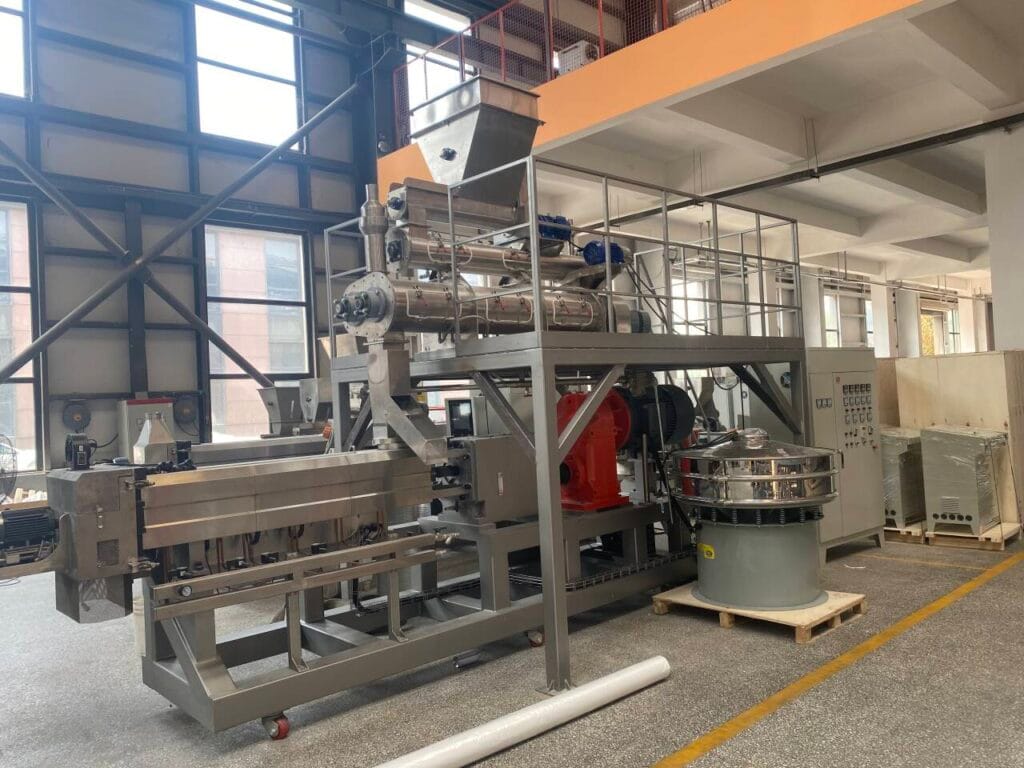
- The Science Behind It: Die pressure is a result of the resistance to flow created by the screw configuration and the die geometry. It serves vital functions:
- Controlling Expansion: For expanded products, the pressure inside the barrel keeps water in a superheated liquid state. The violent flash-off of this water into steam upon exit is what causes the puffing. A stable, high die pressure is essential for uniform expansion.
- Metering and Homogenizing: The high-pressure zone just before the die acts as a final mixing and homogenizing chamber, ensuring a consistent melt is presented to every hole of the die.
- Wear Indicator: A gradual drop in die pressure for the same recipe and screw speed is a strong indicator of increasing screw and barrel wear.
- Operational Protocol: Always install and monitor a reliable pressure transducer near the die. Establish a target operating range for each product. A sudden change in pressure can signal a feed problem, a blockage, or a mechanical failure. Never ignore pressure trends.snack extruder machine
Pillar 4: The Sentinel’s Duty – Continuous Process Monitoring and Data Analysis
An extruder operator must be more than a machine-minder; they must be a data analyst, constantly interpreting signals from the machine to predict and prevent issues.
4.1. The Holy Trinity of Monitoring: Motor Load, SME, and Product Temperature
These three parameters, viewed together, tell the complete story of what is happening inside the extruder.
- Motor Load (Amperage): A direct measure of the torque on the screws. It is sensitive to feedstock viscosity, moisture, fat content, and screw/barrel wear.
- Specific Mechanical Energy (SME): This is the most insightful parameter. It is calculated as: SME (kWh/kg) = (Motor Load kW) / (Mass Flow Rate kg/h). It quantifies the mechanical cooking energy absorbed by the product per unit mass. It correlates directly with product properties like degree of cook, expansion, and texture.
- Product Temperature: The final thermal result of both mechanical and external heating.
- Operational Protocol: Correlate these three parameters. For example:
- High Motor Load + High SME + Low Product Temp: Indicates a high-viscosity recipe with high shear but insufficient external heating.
- Low Motor Load + Low SME + High Product Temp: Indicates a low-viscosity recipe (perhaps too much water or fat) where the product temperature is being driven mainly by external barrel heating.
- Gradually Increasing Motor Load + Stable SME: Suggests increasing component wear.
Plotting these parameters on a trend chart over time is invaluable for troubleshooting and maintaining consistency.snack extruder machine
4.2. Sensory Feedback: The Power of Sight, Sound, and Smell
While data is critical, the human senses remain powerful diagnostic tools.
- Sight: Observe the product exiting the die. Is the expansion consistent? Is the shape perfect? Are there streaks of ungelatinized material? Is the surface smooth or rough? A rough, “shark-skinned” surface can indicate low moisture or excessive pressure at the die.
- Sound: A seasoned operator knows the sound of a smoothly running extruder. Changes in sound—increased grinding, knocking, or vibration—can be the first sign of a mechanical problem like a worn thrust bearing or a broken screw element.
- Smell: The smell of burnt product is an obvious red flag. More subtle shifts in aroma can indicate changes in raw material quality or the onset of the Maillard reaction.
Pillar 5: The Non-Negotiable – Comprehensive Safety Protocols
An extruder is a powerful industrial machine that operates under high pressure, high temperature, and with massive mechanical forces. Safety cannot be compromised.
5.1. Lockout-Tagout (LOTO) and Die Cleaning
The most hazardous routine task is cleaning or changing the die assembly.
- The Risk: The die contains material under extremely high pressure and temperature. If the die bolts are loosened before the pressure is fully dissipated, the die plate can be ejected with explosive force, causing severe injury or death.
- Operational Protocol: A strict, non-negotiable LOTO procedure must be in place.
- Stop the extruder and all feed systems.
- Isolate and lock out all energy sources: main motor, feeder motors, pump motors.
- Slowly and carefully loosen the die bolts in a specific sequence, allowing pressure to bleed off gradually from behind the die plate. Stand to the side during this process.
- Only when all bolts are removed and the die is confirmed to be free of pressure should it be removed for cleaning.
5.2. Guarding and Emergency Stops
All rotating parts, especially the screw shafts at the feed end, must be fully guarded to prevent entanglement. Emergency stop buttons must be clearly visible, accessible, and regularly tested. Operators must be drilled on emergency procedures.
Pillar 6: The Final Act – Systematic Startup and Shutdown Procedures
How an extruder is started and stopped has a major impact on its lifespan and the quality of the next production run.
6.1. The Controlled Startup
A cold start is hard on the equipment. The goal is to gradually bring the extruder to operating conditions.
- Operational Protocol:
- Start with the extruder barrel empty and the die assembly removed or opened up.
- Start the main motor at a very low screw speed (e.g., 10-20 RPM).
- Begin heating the barrel segments to their target temperatures.
- Once temperatures are near target, begin feeding a “startup” recipe, often a high-moisture, low-fiber material, to gently fill the extruder and build pressure.
- Gradually introduce the production recipe and adjust parameters until stable.
6.2. The Orderly Shutdown
The primary goal of a shutdown is to prevent the cooked material from hardening inside the machine, which would require a difficult, time-consuming, and potentially damaging cleanup.
- Operational Protocol:
- Switch the feed from the production recipe to a “purge” material. This is typically a high-moisture, high-oil, or high-fiber recipe (e.g., soy grits, oat bran, sugar) designed to push the production material out of the barrel and leave a protective, non-hardening coating on the screws and barrel.
- Once the purge material is seen exiting the die (usually a color or texture change), stop the feeder.
- Allow the extruder to run until the motor load drops significantly, indicating the barrel is nearly empty.
- Slowly add water to the preconditioner and/or barrel to cool the system and create a steam purge.
- Once the output is mostly steam and water, stop the main motor.
- Begin cooling the barrel jackets and disassemble the die and screw for cleaning while still warm, not hot.

Operating a food extruder with precision and expertise is a multifaceted challenge that demands a deep understanding of the machine’s mechanical, thermal, and rheological principles. snack extruder machineBy focusing on these six pillars—from the foundational consistency of raw materials to the disciplined execution of safety and shutdown procedures—operators and engineers can elevate their practice from mere operation to true mastery. This approach ensures not only the production of superior quality food products but also the maximization of equipment life, the minimization of downtime, and the unwavering safety of all personnel involved. The extruder, in the hands of a knowledgeable operator, becomes not just a machine, but a reliable partner in innovation.
Leave A Comment